In 1791, the Russian Ruler, Catherine the Great, identified specific portions of her realm in which Jews were permitted to permanently reside. This area became known as the “Pale of Settlement.”
There had long been various kinds of limitations on Jews within what is now known as Eastern Europe. Jews were seen by majority Christian communities as foreign, suspicious, and even dangerous apostates. For hundreds of years before the 1791 edict, Eastern European Jewish life was centered on yeshivas – which were institutions for religious, social and cultural study – and shtetls, small villages of impoverished tradesmen and small farmers.
More than 30 years ago, some of my mother’s relatives put together a family tree of those yeshiva-bochers and shtetl-dwelling ancestors with the surname Antolept. It listed names, dates of birth and death, marital relationships, and little or no additional information. This green and white covered pull-out document was distributed to the known Antolept descendants whose shared history started 150 years ago in the Pale of Settlement but who have since scattered around the Earth in six continents. (Who knows, there may also be an Antolept in Antarctica that we don’t know about. An alliterative homerun!)
About five years ago, after extensive genealogical research by a new generation of family historians, a gathering of nearly 100 Antolept progeny met in New York City. It was a quick few days of greetings and storytelling. For me, the event was both illuminating and fun. But it was only a small taste of what there was to learn about those people who stayed and those who fled poverty and oppression, as well as a strong cultural homogeneity in what is now Lithuania. I wanted fuller connections, and the primary purpose of this foreign travel was to whet my appetite for and deepen my knowledge of family lore.
As my trip moved from Turkey to South Africa and then on to Israel, I stayed in the homes, shared meals, and got to know with greater intimacy, some wonderful members of my family, who like me, now lived “beyond the pale.”
The most popularly known depiction of shtetl life in modern culture is, of course, the play and movie “Fiddler on the Roof.” It was a sad but also sweet coincidence for this blog purpose then, that the man who was initially reluctant to take the role of Tevye the Milkman, in the 1971 movie, but who went on to play Tevye over 3500 times in theater throughout the world, Chaim Topol, just passed away a few days ago at the age of 87.
With theater on my mind, and in search of a means of structuring this blog entry to orient readers to the last two-plus weeks of travel, I will introduce you all to my family under the classic western theatrical rubric:
Dramatis Personae
For all of South Africa, and most Israel, I met with the progeny of Moishe Hershel Antolept and his wife Chava Jaffe Antolept. They are my great grandparents on my mother’s side. For two nights I stayed with Chava’s brother’s family line.
The Swerskys of Johannesburg (Joburg)
My mother’s aunt Frieda Antolept (my grandfather’s sister) married Simon Swersky in South Africa. They had five children, Lillian, Abie, Harry, Mavis and Alec (who died long ago). On the first three South African nights, I stayed in the home of Ruth Nicola, daughter of Abie.
Ruth is a writer, educator, and editor. Jean and I had gone on safari with her 15 years before in our only previous visit to South Africa. We also met with her and her close friend, Grant, in Nova Scotia, a few years later and have kept in touch with writing and phone and zoom over the years.
A selfie with Joy, Padma, Ruth and Roberto at Joy’s Joberg home.
On my first night, Ruth and I went over for dinner at the home of Joy Stein. I first met Joy when she was traveling the US as a young woman, slightly older than myself. At her Joburg home, we had a delicious meal and a lively and warm conversation with Joy’s brother Swami Padmapadananda (aka Raymond Stein), and her significant other, Roberto. Joy and Swami are the children of Lillian Stein and grandchildren of Frieda Antolept (Frieda was my mother’s aunt). I also briefly met Josh, Joy’s son.
2. The Castles of Cape Town
Along with her older sister Adele, Sybil Castle is the last of my mother’s generation still alive. And she is very much alive! The youngest daughter of the youngest daughter of Moishe Hershel Antolept. For my first three nights in Cape Town, I stayed with her son Gary Castle and wife Janine’s home in a pleasant suburban neighborhood of Cape Town. There, they are in the process of raising Samuel (who has stayed in our Olympia home parts of the last two Decembers while on winter break from college in the USA Great Plains), Brandon and Anna. While at their home, we had a family gathering which included Sybil’s other, older son David Castle and his wife Debbie and two daughters Rachel and Anna; as well as her daughter Elana Castle Smut’s family which flew in from New York, including husband Grant and children Jonah and Leah.
A Castle of beauties, from left Debbie, Ella, Rachel, Leah, and Anna
3. The Itais of Israel
In my first visit to Israel in 1994, I visited cousins in the very northern tip of Israel, who came to their country by way of Kibbutz Kfar Giladi.[1] I met at that time the original Israeli immigrant from our family, Shirshara Jaffe Itai, who was Moishe Hershel and Chava’s niece. Shirshara had several children, including Yuval who went on to a career as a mariner and many other trades, Avner who became Israel’s foremost choral director, Shula who stayed in the kibbutz and became an educator, and Hemy, her youngest, who became a hardware designer and one of the principal creators of what we now call “smart cards.” You know, like credit cards, things that computers can read. Not an insignificant contribution.
Hemy takes me to the Alawite village of Ghajar, in the Golan Heights adjacent to (and disputably within) Lebanon.
For my first two nights in Israel, I stayed (actually convalesced! For more on that see a later blog entry.) in Hemy and his wonderful wife Anat Itai’s beautiful country home in Beit Hilel, which is located in Israel’s northern Hula Valley.
4. The Brahms’ of Ra’anana
Sybil Castle’s older sister Adele Brahms, had visited our home in Bellevue when I was nine years old. I called her “Miss South Africa” because I thought she was beautiful and heard that she won a “best legs” contest in what was then my pre-feminist awareness period. She also, apparently, won some speed typing award, but what I remember most was just hanging out with her for what probably was a couple of weeks. Adele went on to make aliyah to Israel, marry an Israeli and mother two children, Daniel and Michal. For the rest of this most recent trip to Israel, I stayed in Daniel (Danny) and his wife Shirly Brahms‘ apartment. It used to be Adele’s apartment. Adele is now toward the fragile end of her long life, and I visited her in her nursing home twice on this trip.
On our first day with car, Danny and Shirly and I visit the ancient city of Caesarea.
5. The Benjamins of Kiryat Yearim
Janine Swersky Benjamin and her husband Brian made aliyah to Israel about 30 years ago and did they ever make a presence since. They have nine children and 49 grandchildren! Self-described as former South African hippies, they now lead lives strictly consistent with halakhic Jewish law and customs. Their daughter Tamar, kindly helped arrange our dinner meeting with Danny and Shirly.
6. The Ports of Bet Shemesh
David Port and his wife Lauren, have three children, Orly, Elisha and Ezra, ages 8, 6, and 4. David, Ruth Nicola’s nephew, is a clinical psychologist, specializing in service to the Haredi community. Lauren is an editor and translator between Hebrew, English and French.
Danny, Shirly and I enjoy the quietest moment of the evening in the exuberant home of David and Lauren Port.
[1] I am extraordinarily proud to have a family connection with this kibbutz and its contribution to the creation of the state of Israel. For more research, there is a movie about its founding and role as a smuggling center into British Mandate-era Palestine.
I have just arrived at Ben Gurion Airport. As I am lugging my two suitcases toward an escalator, a hefty middle-aged man intervened. Looking straight at me with a non-friendly, insistent voice, he said something quickly in Hebrew and pointed to the escalator.
“Slicha, aval ani lo mitaber Ivrit. Mitaber Anglit?” I spit out in my best attempt to remember a language I had utterly failed to master 4 years ago. (I THINK I was saying “Sorry bud, but I don’t speak Hebrew. Do you speak English?)
So he said it again in English. “Don’t take the escalator with those suitcases. Take the elevator which is over there, around the corner. Don’t you know that it’s dangerous to use the escalator!”
What do I do? I say “B’seder (OK), and follow his instructions.
But then, as I’m inside the elevator after pushing the up button, I think, “What the heck is he talking about? People take luggage on escalators all the time. What chutzpah for him to say that!”
But then I think, “Wait, maybe he is just a guy with good intentions. He doesn’t want me to hurt myself.” I get off the elevator after a safe 20ft trip.
But then I think, “Does he go around monitoring others behavior all the time? What right does he have to pronounce unrequested judgments upon them? And doing so, even with the best of intentions, why does he do it with an absolutely arrogant and barrier-crushing manner?”
And then I think, “Of course he does. He’s an Israeli.”
At the Istanbul airport there were a series of prominent electronic reader boards that had the same message throughout the concourses. They identified how to give relief support for earthquake victims and rotated the expression “thank you for your support” in multiple international languages and alphabets. Amongst the languages I spotted were Turkish, Arabic, French, German, Greek, Hebrew, Russian and Chinese.
Arriving in South Africa
Deplaning at Johannesburg’s Tambo International Airport, all signs were in English, with some in Afrikaans and what I believe was Xhosa. My first priority upon entering a concourse was to find the toilet. “Welcome to my office,” proclaimed the bathroom attendant, who, I observed, repeated it to all as a standard greeting.
Waking up for my one full day in Istanbul, I pack, make my way to the hotel’s reception desk, and have them stow my luggage until the evening taxi to the airport. Fatima, the concierge who had messed up my tour date, was sitting blithely at her concierge desk. I approached. She of course acknowledged the scheduling confusion, and then our conversation went on from there as I waited for the T-9 tour to begin.
She was a beautiful doe-eyed woman, I would guess in her late 20’s. Well mannered and professionally attired.
“Fatima, I must acknowledge that deep sadness you all must feel about the tragedy facing your country from the earthquakes’ horrible effects.” A second large earthquake had just happened the previous day, which added to their misery.
“Thank you,” she replied, as her face softened, and eyes deepened. “Yes, it is very painful. I have lost many friends.” She went on to provide details of those whom she had heard perish and those who had been providing her reports.
Istanbul was more than 1000 kilometers from the epicenter of the quakes, yet the effects on the mood and economy and logistical organizing functions of Turkey’s biggest metropolis were palpable and profound.
“You know, as hard as this has been for me,” Fatima continued, “it has been more difficult for Naseem (the other concierge who was so calm with me the night before).”
“How so?” I inquired with some trepidation.
“Naseem is Syrian. He is from Aleppo and has come as a refugee. A week before the earthquake, he had traveled back home to bury his mother who had died from an illness. Then he returned to Istanbul, only to discover that the earthquake soon took many in his family. A family already separated by war and death.” Fatima said all this in a slow, almost emotionless manner.
In my reaction to Fatima’s words I expressed empathy as best I could. I told her that it seemed odd, almost an expression of indifference, to be taking a normal tourist jaunt to see the sights. But also, it was important to provide Turkey support, even if it is simply economic support. I had previously asked for a place to contribute to the relief effort and gave a nominal amount to that cause. Now, I would carry on with my 36-hour tourist function.
I waited outside the lobby for a while until the other tour participant made it downstairs from his room. His name was Mohammed, a 30-something, powerfully built Pakistani-American from New York. He clearly appeared to work out a lot, a perception that was confirmed frequently by him the rest of the day.
Mohammed had immigrated to Brooklyn as a teen and told me the classic hard-working-immigrant-makes-good story. He was now married with four children. An acknowledged non-devout Muslim, he nevertheless was devoted to his mother, proud of his accomplishments in business (he ran a service which catered to wealthy clients, like Cardi B and Bill Gates), and was a caring and responsible dad to his children. He also showed me – unsolicited mind you – a picture of the Moroccan prostitute whose services he had secured the night before (probably why he was a bit late to the starting gate that morning.) And yes… of course I demurred at his offer to see more pictures or get her WhatsApp number.
Mohammed and I climbed into a van which wound its way through the warren of narrow two-way streets leading eventually to the waterfront and the boat that would be the starting off point for our tour. Istanbul is massive. A megacity of somewhere between 15 and 20 million people. Apparently, no one really has a grasp on the actual non-official population, as it is a waystation of souls going hither and yon from catastrophes to hoped-for havens. But the inner city street grid is humorously – or more responsibility labeled dangerously – inadequate to its task. Frequently on our passage to the boat, our van or oncoming vehicles would need to retreat in order to find a way to pull off to the side and let the other vehicle pass.
The van drivers knew no English, and there was no “interpretation” of the city we were moving through. So, the tour clearly had not begun. Nor did it begin when we were pointed in the direction of the boat and told to come aboard. We waited close to 30 minutes on the boat, while other tour group members joined us, but finally, the tour got underway with orientations by two guides who would trade off with explanations of the city’s sites and histories in heavily accented Russian, Turkish and English.
Istanbul, the “crossroads of the world” was certainly showing its propers by the diversity of the tour participants. Of the 50 or so tourists on the boat, only Mohammed and I were acknowledged USA Americans. I saw and/or talked with Brazilians, Columbians, Peruvians, Turks, Italians, Germans, Dutch, Swedes, Canadians, Asian Indians, Chinese, Nigerians, and lots and lots of Russians.
Funny thing about being an American. Or probably more specifically an old, tall, single, white American. More than once on this trip, I have been asked to BE in a picture with families. Not take a picture of them. Rather, have them take a picture of me with them. I felt like some kind of curiosity. They must get back home and show their friends, “Look Natasha, here we are with a real, live American old man! Doesn’t he look funny? And he talked with that hilarious flat accent just like the movies.”
It was so awkward, with hidden feelings and thoughts, to be talking with Russians. We clearly were in a proxy war in Ukraine, yet I wouldn’t dream of opening up that can of worms. A Russian grandma, mother and college-aged daughter were traveling together. The daughter asked me to join them in a picture.
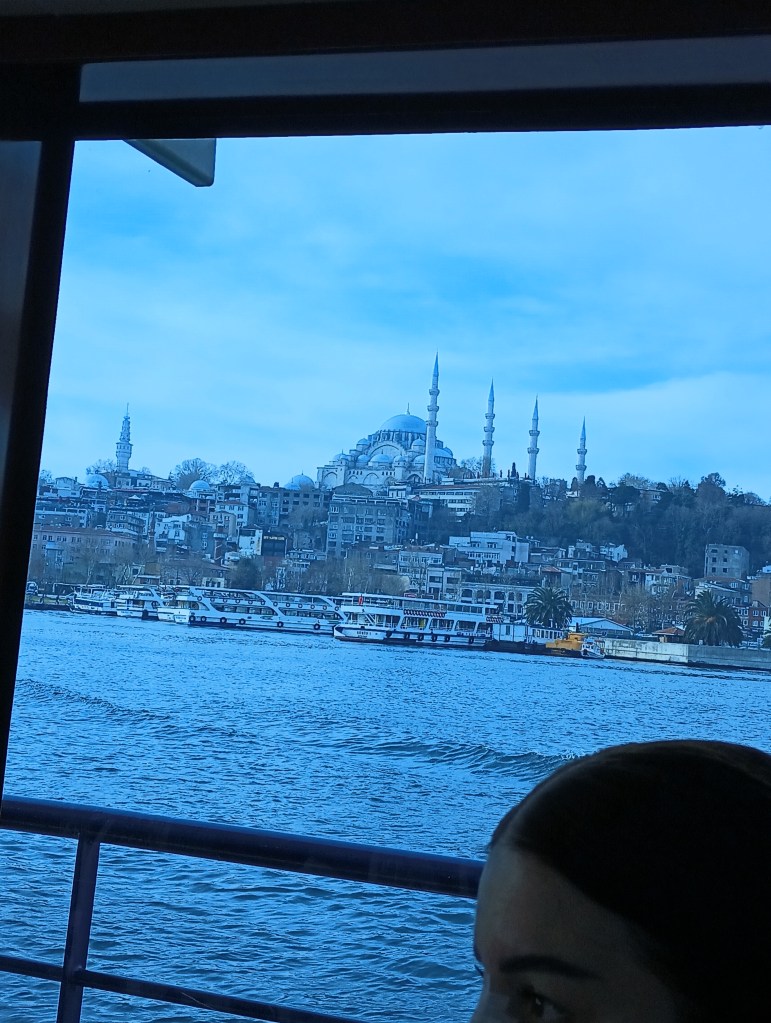
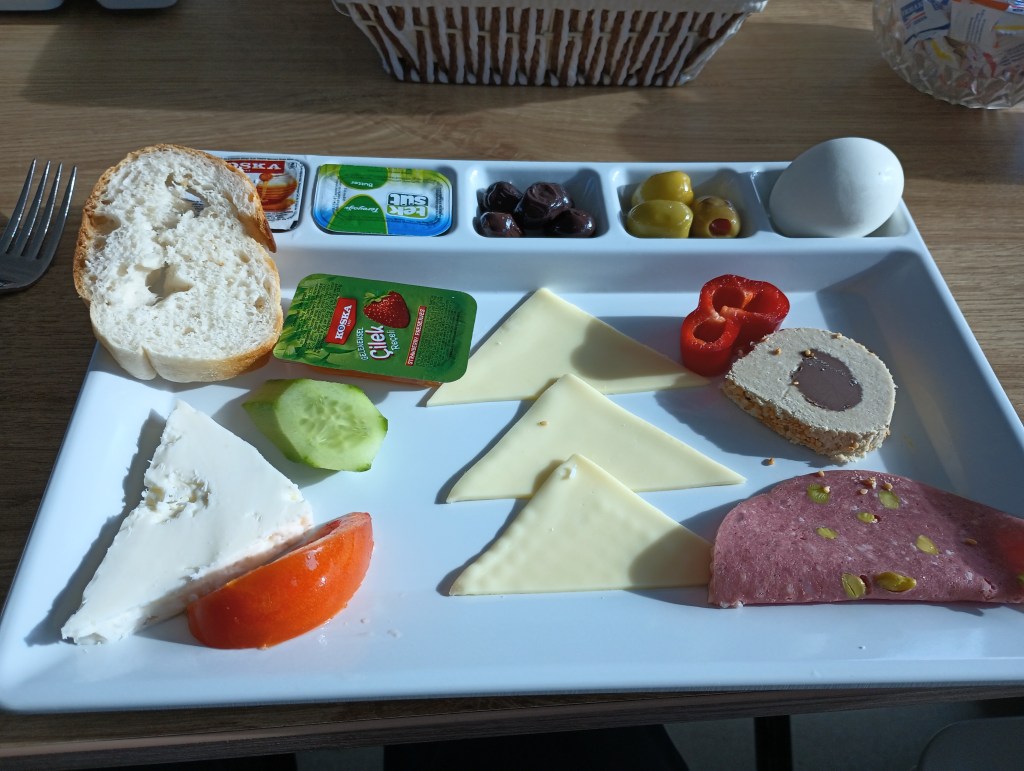
Kadir Agir was the name of tour guide. Funny, enjoyable and authoritative. As we finally got underway on the boat, he described the day’s plan. First, we’d get a breakfast served in the covered hold as we traveled down the Golden Horn; a fiord-like bay on the European side of the city which was a key commercial focal point for thousands of years.
The breakfast was terrific!
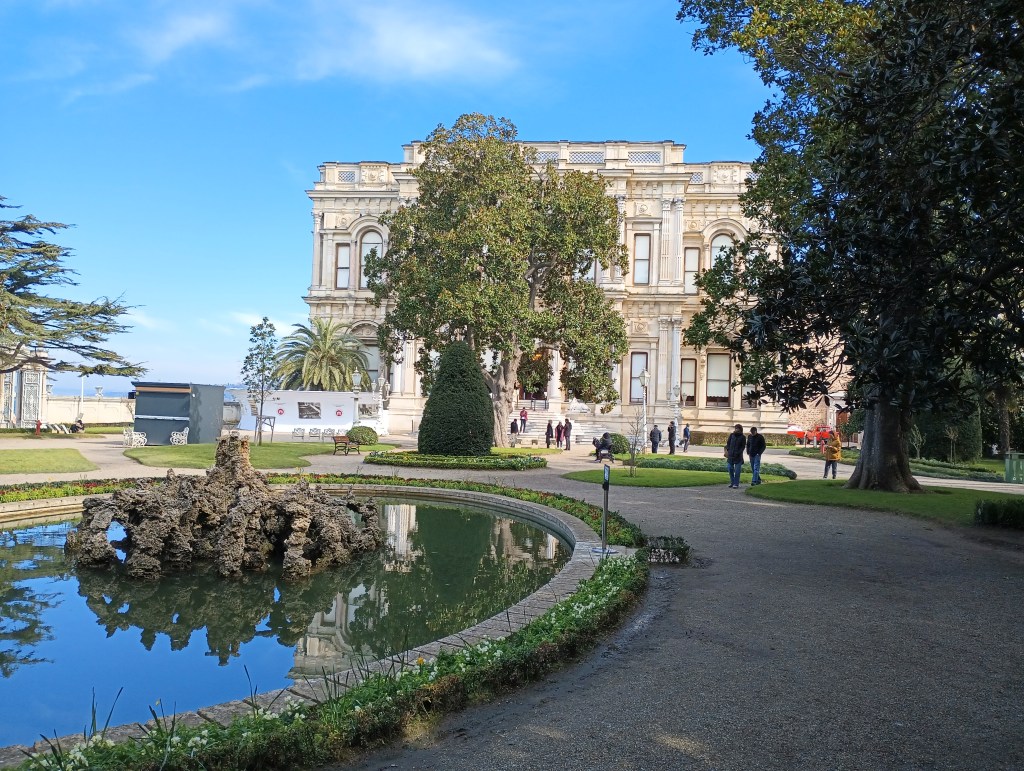
A Sultan’s summer palace.
After the meal, we’d go ashore and visit a Sultan’s summer palace. Then we’d travel by boat up the Bosporus as Kadir would point out key historic sites. This would be followed by a bus trip on the Asian side to visit promontories and parks (including an elevated cableway ride). Then back over to the European side for a lunch overlooking the Bosporus, a visit to Erdogan’s recently completed Grand Mosque, and a ride back to our hotels in the Old City.
A few gleanings from the tour:
The European side has most of the jobs, more of the people, and much higher prices for housing than the Asian side. So, many of the lower-skilled workers would sleep in Asia and commute 4 hours a day for jobs in Europe.
Erdogan and his supporters have made major efforts – with much success – in moving away from Ataturk’s vision of the country led by a secular (non-Muslim) government. That evolving vision is displayed in many ways in the built environment. For example, the Hagia Sophia (https://en.wikipedia.org/wiki/Hagia_Sophia) was built as a Christian church about 1500 years ago, converted to a Muslim mosque, converted by Ataturk into a national museum, and now converted back to a mosque.
There is a grand synagogue still prominent from the Bosporus, but visitation is only through a rigorous security protocol.
Inside Erdogan’s giant new mosque – completed in 2019
As is my usual pattern, I found myself virtually the only one asking detailed questions of Kadir. I think he genuinely appreciated the explorations of culture and governmental structure and I enjoyed very much our interactions.
Earlier, I had asked Fatima if it was possible to visit some of the Old City sites on foot that I had hoped to see on the T-5 tour. She advised that I tell the tour guide of my desire to be let off by the Spice Bazaar, and walk from there. As our tour proceeded, a Peruvian student, Roxanna, who was getting her Masters in Business Administration in Germany, and I connected over our joint Spanish language abilities (Yes, Juani, I CAN speak and understand well enough for it to be a relief from the tower of Babel we were surrounded with). So by the end of our tour, Roxanna and Mohammed joined me for a walking tour of the Old City.
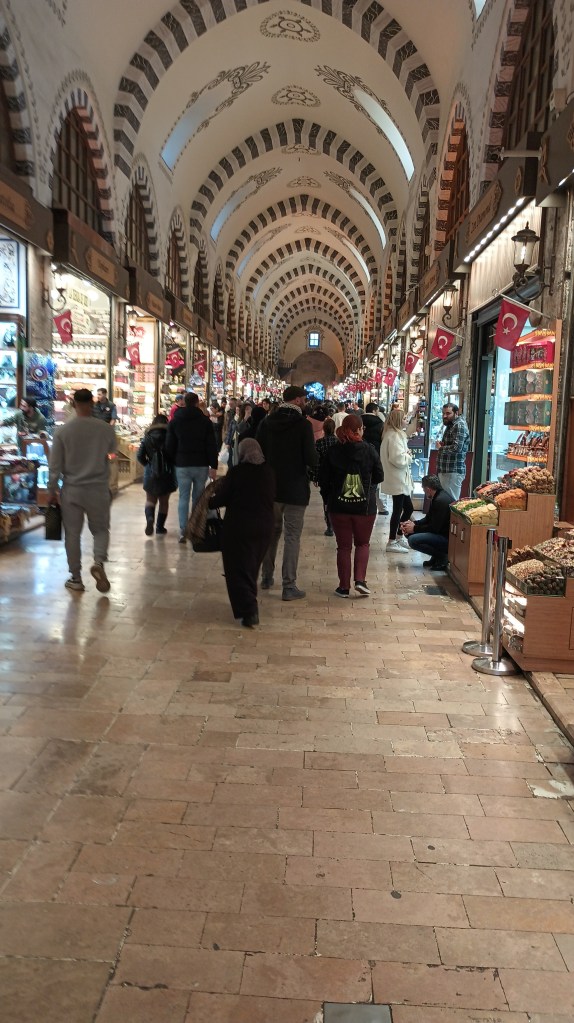
We walked into the explosively wonderful smells of the Spice Bazaar. Together we walked past – but not into – the Hagia Sophia, Blue Mosque, Basilica Cistern, and Topkapi Palace. We did dive into the enormous and lively Grand Bazaar. Mohammed was in search of goodies for his children. In particular he sought a present for his son who would be deeply disappointed if he didn’t get something, since the girls had already been shopped for.
Inside Istanbul’s Grand Bazaar
It was getting late, and I was exhausted. So we walked Roxanna back to her hotel (the opposite direction as ours), and we had a small bite to eat before walking back to our hotel. (I got over 20,000 steps in this day, for which I was rewarded with fireworks on my wrist from the Fitbit.)
I was ready to pick up my luggage and head for the airport. But first I wanted to give my thanks to Naseem for his encouragement in taking what ended up being quite a pleasant and informative tour.
“Naseem, “ I said. “Thanks so much for your help. You were right. It was a good tour.”
He politely inquired as to my welfare.
“Naseem, I hope it is not too invasive, but I want you to know that Fatima told me of the great tragedies you have experienced in your family and with your country. I am so sorry for your losses.”
As we walked with my luggage to the front door of the hotel and a waiting taxi, Naseem and I stopped for a moment. I asked him, “Naseem, how much loss can one person handle?”
He squared up, looking directly at me, and said, “quite a lot.” Then he reached out his arms, in the universal sign to come closer. Smiled a soft smile, placed his hands on my shoulders and kissed me on both cheeks.
At the embrace, I held back tears.
The taxi ride to the airport was relatively fast – well past rush hour – and the driver much warmer and talkative than the fellow who brought me to the Old City the day before. He liked Steph Curry and the NBA’s Golden State Warriors. At the end of the ride, my credit card and debit card still didn’t work. I used the last of my dollars to pay the fare and proceeded to hang out at the airport for several hours prior to the overnight to Johannesburg. It was a whirlwind and emotional visit to a traumatized country. And I was ready to be embraced in another way. This time by family.
It was supposed to be quick, and it was supposed to be easy.
Walk off the plane bleary-eyed after an 11-hour all-nighter Seattle flight to Istanbul’s new and massive airport. Go routinely through passport control. Hop on a taxi and settle in for a good night’s sleep in the historic Crown Plaza Old City hotel. Then off the next morning on an Old City group tour of the Hagia Sofia and other classic highlights. Yeah… the blog entry’s title predicts the next sentence. There were plenty of bumps in the road.
Let’s list the bumps, shall we?
Bump #1: No one ever told me that Americans – and I think ONLY Americans – need a visa to leave the airport. Cost? $30… to be paid ONLY in dollars. I hear about this peripherally on the plane for the first time, but the reality fully dawns only after waiting 20 minutes on the Passport Control line, reaching the control agent, and being told that I need to go back and get the darn visa.
Bump #2: Like the perfect analogy for the entire Erdogan transformation, Turkey has closed the more central Ataturk airport to passenger traffic, replaced it with a grander, modern version more than 30km from the city core, and required visitors to support the Turkish economy by paying for taxi service.
My taxi driver spoke virtually no English and was determined to – and effective at – resisting my charming efforts at polite conversation. When we arrived at the hotel, after an hour of wending our way through awful traffic – somehow both my credit and debit cards did not work on his machine. While I had sufficient US dollars to pay him in cash, my foreign journey had thus begun with the dangerous perception that either he had just somehow ripped me off, stolen my card identities, or my cards wouldn’t work at all. (Thankfully, I now believe none of that is true, but will await final word when I return to the States.)
Lobby of the Istanbul Crown Plaza – Old City
Bump # 3: Arriving finally at the hotel lobby – which was almost comically ornate for a middle-brow place to rest one’s head upon the pillows – I approached the concierge desk while waiting (for about 15 minutes) to check in.
“Hello, my name is Daniel Farber and I just want to confirm my reservation the next morning for the T-5 Old City Tour,” I say to a well-dressed gentleman standing in the small open office to the right of the hotel registry desk. The concierge, whom I later found out to be named Naseem, faced me with a polite but troubled look on his face.
“I’m sorry sir, but tomorrow is Tuesday, and the T-5 tour doesn’t occur on that date. Most of the sites are closed on Tuesday. Can we change that to Wednesday?”
“What? No, I’m leaving the city Wednesday early morning. Why didn’t Fatima – who had made the reservation for me – mention this?”
Naseem was calm and patient, and suggested that the T-9 tour would be lovely. I was tired, irritated and resistant. T-9 involved a boat trip, bus tour, and nothing in the Old City. I had no interest in plying the waters of the Bosporus and Golden Horn. But Naseem gently extolled the virtues of T-9 and I came to grips with the reality of my situation. I didn’t have any choices for the next day other than solo explorations in a country where I didn’t know the language – at all. Also, it hit me hard. What did I have to complain about? This country was in trauma with the enormous tragedy of a devasting earthquake. My disappointments were petty. So, I signed up for T-9.
It appeared that every third store in this tourist area featured Turkish Delight.
Bump #4: Before going to bed, I wanted to buy some Turkish Delight for my South African and Israeli hosts, and get a small bite to eat. I asked the front desk about places nearby and was given directions which befuddled me. So I took off on my own to find something simple. Two blocks down and around the corner was a street-side kabab place with a rustic back of the store sit-down eating area. Perfect. A cheap, authentic and tasty doner kabab where I appeared to be the only tourist in sight. Down it with Pepsi and I’m ready for a long night’s sleep.
A doner kabab and Pepsi hit the spot.
But then, there was the little matter of returning to the hotel. I decided to make a big loop back home and proceeded to get completely lost. Asked several folks “Crown Plaza Hotel” and in broken English after broken English – or no English – I kept being given different instructions. My vaunted sense of direction betrayed me. But exhausted, I finally did make it back to the hotel and quickly fell fast asleep.
A 2023 Journey to Türkiye, South Africa and Israel
In my enthusiastic naivete of autumn 2022, I wanted a trip to see family abroad. Dear Cousin Sybil in South Africa made it plain that 15-hour flights to America were no longer in her wheelhouse, and various Israeli relatives, beckoning since my initial 2019 foray into retirement, were now “Covid accessible.” While Jean demurred from long flights, I’d go anywhere. 2023 was to be all about “yes” and I was excited to get that underway with a flourish.
Cheaper flights could be booked on Turkish Airlines, and what the heck, why not spend 36 hours in Turkey? A quick sprint overnight to Istanbul’s Old City, a day tour of the Hagia Sofia, Blue Mosque, Basilica Cistern, and Topkapi Palace, and I’d be on my way to Johannesburg. A nice way to adjust to the trip’s new time zone.
But post booking, events, both tragic and profound, intervened.
In Türkiye and Syria, the toll of horrendous earthquakes which occurred both during and right before my arrival now approach 50,000 dead. An ongoing and worsening failure of the electrical grid resulting in rolling blackouts (load-shedding) and roiling politics (poisoning of the national administrator when he was blowing the whistle on corruption), is gripping South Africa. And oh yes, Israel elected its most right-wing government in history, resulting in hundreds of thousands of protesters hitting the streets and yet more spasms of violence between Palestinians Arabs, Jewish West Bank settlers, and Israeli government police and military forces.
The streams between democracy and autocracy seem particularly fluid now within these three pivotal world nations. All three have their feet in both “the West” and the “2nd World” of Russia and China. Their stances on the war in Ukraine, as the most significant current example, are complex and nuanced.
In Türkiye, growing autocratic rule by Recep Tayyip Erdoğan will be tested by an election set for May. The legitimacy of previous elections has been called into question by human rights NGOs, and some see the next vote as the last chance before anti-democratic rule settles in for a long run. Both a part of Europe and a part of Asia, Türkiye borders Syria, Iran, the republics of the old USSR and the cradle of democracy in Greece. It was the center of what was most certainly one of the most powerful realms the world has ever known for 600 years – the Ottoman Empire. So, it’s been pretty good at pulling off autocratic rule, and might find that comfort zone again.
In South Africa, the miracle that was the relatively peaceful transition from White minority rule under Apartheid to the Rainbow Nation vision of Nelson Mandela continues to both inspire and deeply disappoint. There has been a complex shift over 30 years from centralized, systemic brutal authority to broadly condemned governing incompetence and corruption. A growing “anti-white” party regularly disrupts parliament. The white wealth bubble remains, with inequality, if anything, even worse than in the old regime. And yet… any yet… it all hasn’t fallen apart. Violent civil war has not taken place. A genuine black middle class has expanded. And public facilities are legally open to all.
In Israel, the new government is proposing or enacting, amongst other changes, legalization of West Bank settlements, expanded differentiation between the rights and privileges of Jews and non-Jews, and limitations on the authority of the judiciary. When I asked my friend David “doesn’t this all seem existential to you?” he replied that Israel always feels like it’s on the existential precipice. Yet somehow, this feels different to me. Autocracy and democracy measured on the balance sheet once again.
The above all seems purely political; a far cry from my initial motivation to see family. But anticipate that these travel reports will be bits of the personal and the social. As usual, context illuminates, but people are the reason to move about the world. And so far – as you will soon read – what amazing people I have met!
About ten years ago, I came up with a concept for a children’s literature series. Inspired, I suppose, by the success of many series books, from “Curious George” to “Nancy Drew.” I nonetheless thought I saw an absence in the genre. There have been plenty of series books which involve a lead character experiencing various adventures of a similar kind, e.g., mysteries, fantasies. There have also been plenty of books which follow a lead character as that character ages. The “Harry Potter” series is a prime example. But has there ever been a literature series which progresses only in its level of sophistication as its readers age? In other words, is there a series with essentially the same story, but delivered to children at their age-appropriate level from the first year of their life to age 17?
To implement this concept, writers and graphic artists would need to have a strong understanding of childhood intellectual and emotional development. I have neither. All I have is this concept.
So, over the years, I have told people “I have a concept that is brilliant, but just needs several people of great skill to carry it out.” I’ve taken it to writer friends. To lawyers to understand whether the “concept” is patentable (it is decidedly not!). To artists. To publishers. The response has been consistent: “Interesting idea, Daniel, why don’t you do it?”
Well, the obvious answer is that I lack the skills and discipline to pull it off. But then I just realized. Hey, I have a blog now. I can send this out to the vast array of my readership (ok… probably about 30 folks, most of whom have already heard this nonsense and most of whom don’t actually read everything I put out here), and see if anyone is open to changing the world.
And with that…here are some details of my publishing concept. Anyone is free to use it, no credit or financial renumeration required.
Here is the distinctiveness of the concept:
We are talking about a publishing series; not just a “book” series. It would be made up of individual publishing events. Each event would indeed include in form a book. But it would also have derivative forms online of ancillary documents, games, other elements.
Each event would be geared to a specific child’s age. The first event would be for a 1-year-old. the second event for a 2-year-old. The third would be for a 3-year-old… and it would continue up until at least age 13. It could proceed to as far as 17. The content and style of each publishing event would be age-appropriate consistent with the best understanding from the fields of children’s literature, education, as well as psychology/sociology.
For each event, the story would be essentially the same. But it would be at an intellectual level that made sense. Thus, the first “book” could have brilliant colors, shapes, faces, and other images with only single words associated with each “page.” But as the sophistication of the story increases with age, there would be more than clear continuity of story line. It would essentially be the same story, with greater and greater depth revealed.
Each event would be revealed once per year. There would be an initial cohort of children who could look forward to the next installment happening next year – hence the creation of a publishing “event” – building excitement for the next installment.
Execution of the Concept
It is desirable – but not required – that the same illustrator would be retained for all events.
It is desirable, but not required – that a different writer/narrator be retained for each event.
In that way, children would have the maximum sense of continuing a journey with familiarity, but also be experiencing a new and creative take on the same story. From a writer’s point of view, it could be exciting to be a part of a successful series, and have responsibility to both the truth of the work of fellow writers, and at the same time, advance the story in unique ways that others would need to work with as each reader ages. From a publishing point of view, it would also be essential to have the very best writers of literature directed at certain ages. Thus, someone who would be best for a 3-year-old, may not be best for a 13-year-old.
Value of the Concept: A Hopeful Conceit
This publishing concept could be international in scope, translated into multiple languages and published throughout the world. The theme and story line would ideally be a basis for expressing universal truths about humanity, and about the process of growing into adulthood. If successful, it would be:
1. A means of continuity throughout anyone’s childhood.
2. Something to look forward to as one ages.
3. Something to share between siblings and friends of different ages.
4. Something that binds people together of different cultures, languages and times.
There. It’s out to the world. I am curious though, whether it is a concept that is truly unique. Or if, somewhere, somehow, such a series now exists.
My ten-day trip to California was shaping up as a COVID-challenging mash-up through the act of gatherings. Concerts with 1000’s of people, home stays with relatives, dining out, watching movies from genuine movie houses. But the day before I was to leave, things were not looking up in the illness department.
I began to feel a kind of uncomfortable heat that was paired with weariness. Was I coming down with something? The thermometer said I was, and in the morning before my late afternoon departure, I canceled a previous morning engagement and went back to bed, half expecting that I might need to cancel the California trip entirely. Thankfully, upon awakening, the temp was back to normal, I was feeling a bit stronger, and decided that the trip would go on.
The plan for the trip: Connect with lots of people, both individually and in large celebratory gatherings. Attend two symphonic concerts and one big birthday bash. Be a tourist and see some sights.
Friday the 2nd to Saturday the 3rd of December
Of course, I wanted to spend time with Zac and Vicky and hear about their recent excursion to Korea – Zac’s first meeting with his new in-laws and the ethnic homeland of his newly minted bride. On my trip’s first day, Zac picked me up at the airport, and we returned to their lovely little central Berkeley home. They prepared a delicious meal, we chatted for awhile and I hit the sleep button hard. The next day Zac and I went to The City by BART and Muni.
Zac makes an aesthetically flamboyant breakfast on my first morning in Berkeley, replete with Grossman’s lox from Santa Rosa, rosemary and tomatoes from their yard, and colorful dollops of some kind of goodness.
Our initial destination was lunch at the best Chinese dumpling house I had ever experienced, (http://www.dumplinghouse.us/ ) which was located in the Castro District. In addition to the tastes and smells of the food, the restaurant’s walls displayed expanded photo-portraits of the stunningly beautiful delectables we were prompted to consume. The physical space was just so right. Not stuffy or pretentious. Focused on excellence in food presentation. There was even a wall-mounted video loop that I found educational and aesthetically exciting, showing how the cooks made the marvelous, heated pastries.
Ahhh… dumplings.
After lunch we took in our first movie of the trip: “White Noise” directed by Noah Baumbach. Zac and I had listened to the original novel by Don DeLillo as a book-on-tape during one of our long-distance car trips together many, many years before. Neither of us felt that the movie – which was described as “the book which is impossible to turn into a movie” – was that great, but the connection to our historic father-son road trip had elevated the desire to see the flick – if only for nostalgic purposes. Later that evening, after returning to Berkeley, the three of us went through a slide show of their Korean visit that Vicky had organized while we were dumpling-ing and movie-ing in San Francisco.
Sunday the 4th of December
Zac’s connection to Berkeley, and his securing of the Managing Editor position at the online news site “Berkeleyside,” was at least somewhat assisted by his – and my – regular visits to the Berkeley Hills home of my uncle and aunt, Joe and Sarah Jaffe. We all became quite close with the elder Jaffes, and almost always paired our one- to two-week stays with visits to their eldest son Peter’s family. Peter became, 28 years ago, the Conductor and Musical Director of the Stockton Symphony, just an hour and a half drive from Berkeley. Peter and wife Janie have three children close to Zac’s age, and earlier this year Zac, Vicky, Jean and I attended one of their sons, Paul’s, wedding celebration to long-time flame and new wife Sophie. Peter and Janie too went to a wedding celebration of Zac and Vicky up in Washington State in July. Another P and J son, Adam, also recently got married to Katie in a COVID constricted ceremony. Their third son, James (more about him later), just announced his engagement to a lass from Omak, Washington. Folks seem to be stampeding to the altar these days! (https://www.omakstampede.org/). Oh heck, while in the same paragraph I might as well mention that my nephew Alex too is engaged… I’ll meet his fiancée in a few days.
I was happy to share the experience of watching Peter lead the orchestra with Zac and Vicky. Peter and Janie kindly secured our tickets for the Sunday matinee performance. Our visit to the Stockton Symphony’s holiday concert was particularly exciting as they would be performing a Hanukkah medley that Peter himself arranged. I had watched the medley performed by another of Peter’s orchestras online but had not seen it in person.
The concert hall was about 2/3rd full, as Peter announced that this was the biggest attendance since the start of the pandemic. (Pre-Covid the place was usually packed.) I enjoyed all the pieces, many of them traditional and delightful Christmas concoctions, with the added fun of “sing-a-long” written lyrics on a electronic banner above the stage. I’m a Jew who really loves to belt out carols! But I was especially moved to listen to and see his Symph-Hanukkah medley. I found myself teary-eyed as I thought of how proud my mother would have been to see her nephew take on the topic with such skill and power and sensitivity.
After the concert, we all went out to dinner at a local Greek Restaurant. As we were being shown to our seats, Peter was recognized by a couple of parties who spontaneously burst into applause. Imagine the thought of walking into rooms and people clapping for you! I’m sure that he has dealt with that before, but there also – and I am just projecting here – may be the additional joy and even relief people feel about finally, after years of pandemic constraints, being able to gather together and share music, art or… food.
Monday to Tuesday, December 5th to 6th
My cousin Roberta, whom we connected with during the Antolept (Jaffe) family reunion 5 years ago and have staying in touch with since, was to perform in the choir for the Santa Rosa Symphony’s production of Beethoven’s Ninth Symphony. She and her partner Stan graciously allowed me to stay with them for a couple of nights and got me a ticket to the symphony.
During the day before the concert, they took me out for wine tasting. This is, after all, Sonoma County. It’s what one does. As I was finishing my third glass from the flight we were drinking, I got a phone call. It was from my former colleague and State Parks commissioner Pat Lantz. She was about to get an award for her contributions to the Gig Harbor community and had questions about Talmudic interpretation as she was preparing her acceptance speech. I pointed out to her the desperation of her position that I would be the most Jewish person she knew, but that she was also in luck. I was sitting down with two folks who actually led Torah and Talmud sessions at their synagogue. I put my phone on speaker mode and the four of us engaged.
What followed with a discussion on Jewish ethics. The centrality of the concept of Tikkun Olam (repair of the world) and the moral teachings in Pirkei Avot (Chapters of our Fathers) https://en.wikipedia.org/wiki/Pirkei_Avot were lead subjects. I unabashedly told Pat that she was an exemplar of those practices in her commitment to – and effectiveness in – advancing the public interest and protecting the natural world. My personal favorite PA quote, whenever I believe that the road ahead on any matter seems too long or steep: “It is not incumbent upon you to complete the work, but neither are you at liberty to desist from it.”
After a delicious sockeye salmon-led dinner prepared by Stan – who said it was the best salmon he ever made and I thought it was pretty terrific as well – we went off to the Green Music Center in Sonoma State University’s Green Music Center in Rohnert Park to attend the symphony. While Roberta went off to practice with the choir, Stan and I attended a pre-concert talk between a key soloist and the symphony musical director, Francesco Lecce-Chong. https://www.srsymphony.org/About/Artistic-Leadership/Francesco-Lecce-Chong,-Music-Director
Toward the end of the session, Lecce-Chong referenced Beethoven’s Ninth as “the most performed symphonic music in the world… by far.” While I certainly had heard/listened to the 9th a number of times, I realized that I may never have listened to the entire piece and certainly had never seen it performed in person.
Weill Hall, where the concert was performed, was a stunning, architectural showpiece of wooden grandeur. The audience fully filled the seats for this performance. The concert was split by an intermission; modern works in the first half, and the 9th in the second. I had no idea about the length of Beethoven’s final symphony which stretched over an hour. His magnum opus, written when he was essentially deaf, was originally performed, apparently, when he and another conductor both led the orchestra. The other conductor’s timing being the sole focus of the performers. Apparently, Beethoven was still swinging his arms after the final note.
Both during intermission and after the show, Stan quickly guided me to a special side room where oer d’oeuvres, sweets, and bubbly were served for those patrons who had given a bit extra to the symphony. I was receiving an undeservedly royal treatment, but, heck, the prawns WERE tasty.
Beethoven’s Ninth Symphony performed by the Santa Rosa Symphony with several community choirs merged in for the full affect. Cousin Roberta is third from the right on the top row.
Wednesday, December 7
Late on Tuesday I received an email from my friend Katrina. We had planned to take a walk and have dinner the next day, but Katrina needed to cancel. So, I decided to have a day by myself in SF. Picked up a tuna wrap, orange and some limeade in Santa Rosa to eat either along the way or when I got to The City. Why limeade? – stay tuned – this will matter later – because it was a smaller container than the lemonade and less expensive than some of the other more processed drinks.
I drove to SF with the intention of filling the afternoon in the de Young Museum. As I entered Golden Gate Park I saw an unlimited time free parking space – this is a big deal in The City – across the street from the SF Botanical Garden. I decided immediately that a leafy stroll was meant to be and spent a good hour walking the paved and unpaved pathways of the gardens in the late autumn midday sunshine. The gardens were arranged by geography and chronology. There were the plants of Chile, South Africa, etc. There were the plants of progressive geologic eras (e.g., Eocene, Pleistocene). Flowers were abundant; what a wonderful change and exaltation from the dreariness of Western Washington’s dark-out Decembers.
I’m planning to go to South Africa in March to visit my dear cousins. I thought I’d get a head start on Cape Town’s Kirstenboschby visiting the San Francisco Botanical Garden.
Off I walked to the de Young Museum, looked at the price, thought about my intention the next day to do SF MOMA and changed plans on the spot. After all, I was on my own, and any changes mattered to no one else but me.
Walking across a broad, palm tree, brick and water fountain sprinkled plaza between the de Young and the California Academy of Science, my new museum destination, I stopped to get a Polish dog and Coke from an outside vendor. I asked for hot mustard, onions, and sauerkraut to be heaped upon the dog, and chomped it down as I took in the view of the plaza, neighboring Ferris wheel and a series of strolling lovers.
Golden Gate Park’s palm plaza, Ferris wheel and nearby hotdog stand between the de Young Museum and California Academy of Sciences
California Academy of Science’s tropical conservatory. A couple of plumage show offs!
I was undecided whether to eat a dinner in SF or cross the Bay Bridge and eat somewhere in Berkeley. My intention was to return to Zac and Vicky’s after dinner. As an option I hadn’t previously considered, I texted San Franciscan James Jaffe, Peter’s son, and asked him “any plans for dinner tonight?” James is a cellist, who specializes in chamber music. To my happy surprise, he called me back and told me that he was managing a concert that evening and dinner would be tough to fit in. Of course, I asked if I could come and help him set up for the event, and we might have a chance to connect a bit before the concert. He quickly accepted.
After I got my own dinner at a fabulous fish fry café/seafood market near the Ocean, that James had previously recommended to me (https://www.hookfishco.com/), I drove out to The Haight to help James set up for the evening’s event. That event would combine chamber music (a string quartet) with three short science lectures by three different scientists. The topics were sound waves, light waves and water waves. The venue was, of course, labeled, “Wave” and James was a founder and leader in The Wave Chamber Music Collective, (https://wavecollectivespace.com/ ) a non-profit organization that promotes classical and contemporary music. James was not performing that evening, but he was co-managing the event.
As I entered the Wave, I was introduced to Christy, the other co-founder of the Collective, and told her I was there to help. She asked me to go across the street to pick up ice at the drug store, which I did. Then James and I needed to go across the street to a liqueur store to pick up various contents for the mixed punch they were concocting. The store didn’t have a sugared lime drink that was part of Christy’s recipe. “Hey, I have some limeade in the car which I haven’t opened yet. Perhaps that would help.”
We fetched the limeade, brought it to Christy and, TA DA, it was perfect!
As people started filling in the venue, I grabbed a corner of the couch in the back of the room, by the one toilet. Eventually, 40 or so people were crunched into the space (Fire Marshals don’t read this blog), most sitting on the floor, cross-legged. It was a 30-something crowd. I saw no one close to my age. Perhaps 20% were, along with me, wearing masks. Before the music started, the din of laugher and joy of discourse and huggings and kissings produced a mood of gaiety (in more ways than one – after all, this IS San Francisco!) and silliness.
Chamber music as it is meant to be played – in a very small chamber with a rapt audience.
Then the quartet started. Its first piece, of recent vintage, provided a surprising and inspiring range in the uses of the traditional string instruments. I love classical pieces and am always delighted and impressed by the power of the string quartet. But that first opus contained sounds I had never heard from those instruments. In addition to the traditional bowing and plucking, there was a surreal hissing created by covering the strings with hands paired with soft bowing. There was too wonderfully odd syncopation and stirring and surprising swings into different modes. When the music started, the audience’s merriment suddenly became a contemplative quiescence, and they all listened with an intensity and appreciation that was enhanced by the tiny space and packed house. The intimacy was thrilling. Oh, how we have missed this for our years of pandemic life! There were feelings upwelling in me both of joy and release from the burdens of isolation and worry about the risks I was taking for my own health and potential damage to others – after all, I was still having some symptoms of chest congestion and dry coughing.
When the quartet finished its first piece, on came the lecture about light waves. The mood instantly changed from reverent listening to collective intellectual guffawing. This was a smart crowd. Very smart. Next to me on the couch was a married couple; he a neuro-physicist doing cutting-edge research, she “in the tech field” working for a startup. He grew up in Bellevue, Washington (my hometown), she grew up in Mumbai. His friend and work colleague was the first scientist up in the comedy-science lectures. “Eric’s a funny guy,” my couchmate informed. “He’s like this at work too.”
The concert resumed, then was interspersed between more lectures and more music. A finale of classic Chopin elevated the room and had me near tears of bliss. After the music ended, and the chatting began, I was introduced by James to a young woman violist who told me of her own struggles to decide whether to drop her tech job in favor of concentrating on the music she loved to play. I thought about the remarkably high levels of talent that the musicians displayed, the joy of their extended will from their brain to their limbs to their instruments, in which they could produce, with a directness and seeming effortlessness, these complex and powerful sounds. And best of all, the wonder of doing that with others… having to do it with others… conjoining the skills and purposes for four people. How could any singular technical accomplishment compare with that sublime collaboration? How could the young friend of James not yearn for what must be a certain extasy of connection with others that has the potential to reach for a perfection of beauty and truth. If you have the chops, how can you not devote your life to making music?
James has filled his life with this stuff. Like his father, his mind is constantly hearing the world around him, taking it in with a growing wisdom and familiarity because he has the capacity to reproduce the sounds from his own talents and the talents of his eager collaborators.
After the concert/comedy science lectures, I drove home in the dark of a metropolitan night, across the Bay, back to my son and his bride.
Thursday, December 8
Every day, every moment on this trip has seemed to build on sets of hilarious and meaningful coincidences and remembrances. The day after James’ concert/lectures, I’m back in San Francisco. This time with my old city planning school colleague and friend Helen Burke. Helen was an elected official when we first met. The first woman and first self-avowed “environmentalist” on the board of the East Bay Municipal Utility District (East Bay MUD). We have stayed in touch over the more than 40 years since our departure from school, with Helen adding a focus on watercolor painting to her environmental planning and advocacy work avocations. We are off to SF MOMA to take in a special exhibition of “Diego Rivera’s America.” The great muralist and devoted communist engaged in his craft in multiple locations throughout Mexico, and in many US cities, including New York, Detroit, and, of course, San Francisco. Rivera called his America “from ice to ice” – the Artic to Patagonia.
Now, every time I think of Rivera, I also think of his wife Frida Kahlo, and then, in turn, think of the terrific movie “Frida” starring the sumptuous Mexican actress Salma Hayak.
Diego and Frida: Not all of Diego Rivera’s America exhibit is painted by Diego.
Later that evening, after driving back to the East Bay, picking up Zac and having a delicious Thai dinner, the three of us went to see the movie “She Said.” It focused on the New York Times journalistic duo, Megan Twohey and Jodi Kantor, tracking down victims of Harvey Weinstein’s sexual violence and seeking to make that story public. Salma Hayek famously told of her experience with Weinstein who would not let her produce “Frida” unless she participated as the titular character in a nude scene. Coincidence between SF MOMA exhibitory and “She Said?” Perhaps not, but things trigger connections with other things.
Friday, December 9
The deal was that I would not interrupt Zac and Vicky as they carried out their work responsibilities during midweek. The weekends we’d have together, but I would scatter otherwise. So, Friday would be my day to write, reminisce, and explore Berkeley on foot.
Bringing along my laptop, I walked over to Shattuck Avenue’s SenS Hotel Café – formerly called the French Hotel Café – where Uncle Joe spent many mornings for 20 years, drinking coffee, eating pastries, and shooting the breeze with the locals. Joe called it the “French Laundry” because that’s what it was before becoming a café. (Little did he know that “The French Laundry” in Napa County would become famous as an ultra-elite dining spot that got Governor Gavin Newsom in trouble during the pandemic for his attendance and obvious hypocrisy https://www.thomaskeller.com/tfl/menu ). The North Berkeley (formerly called the Gourmet Ghetto) café is now managed by Spanish-speaking staff. When I mentioned to the man serving me a latte and scone that my uncle had come here for decades, he pointed to a man sitting in the corner and said, “You ought to talk to that guy.”
Author and social observer Leonard “Lenny” Pitt holding forth at Shattuck Avenue’s French Hotel Café, where my Uncle Joe spent pleasant mornings drinking coffee, eating pastries, conversing about whatever, and playing/singing folk music for over 20 years.
“That guy” turned about to be Leonard “Lenny” Pitt. Lenny had been hanging out at the French Hotel Café for over 30 years. He is a published author of many books, including several on walks and architecture in Paris. (http://www.leonardpitt.com/.) Some wildly famous or talented old fart sitting in the corner is, of course, no surprise in Berkeley. Choose any restaurant in this town and just listen to those in the neighboring table casually reference their latest film, scientific breakthrough, or novel. There is a presumption of intellectual greatness in the town that comes mixed with one’s eggs over easy and hash browns. Zac runs into Michael Pollan on College Ave. Jean and I are eating with Helen at Saul’s as Robert Reich explains the latest deprivations of the Trump Administration to his acolytes at the table to the left (in more ways than one). It all comes with the territory.
So, I strike up a conversation with Lenny who is happy to engage. Turns out, he and other café denizens have just produced a book, “The French Hotel: Selected Writings of Café Habitués” which will have a big book opening party in 8 days. Lenny sells me an advanced copy for $10. “I can’t promise anything,” I tell him, “but I think covering the opening party in Berkeleyside would be a great article. I’ll tell my son Zac about it.”
I had already proudly told Lenny of my history with Sarah and Joe, Joe’s connection to the café and Zac’s connection to town and the news site. Lenny avidly read Berkeleyside and was pleased with the potential for promotion. He was also working on a video of the history of café patrons. He promised he’d send me the video when it was done, but showed me what he had so far – a 10-minute paeon to alter kockers hanging out. We exchanged email addresses.
I asked Lenny the obvious. “Did you know my uncle?” He asked me for a picture, and I was able to dredge one up from my unsorted online picture collection.
Turns out, Lenny didn’t recognize Joe, but he walked around the café until he found a long-timer who did. “She does remember him,” Lenny calmly told me. I was thrilled.
Lenny and I talked intermittently till he needed to leave. “I’m here seven days a week. Come by anytime.” I told him I’m leaving on Monday morning but will come back next time I’m in Berkeley.
The café closed at 2pm, and with the Lenny dialogs taking up a share of my time, my trip write-up had a long way to go (finishing it now, back home in Olympia). But the rain was holding off for the day, and the temperature was perfect for a long walk up to Sarah and Joe’s, over to Codornices Park, and down to the Euclid Ave Cal campus entrance.
Loudly marching and picketing at the entrance were about 50 graduate students. Music was blaring and bullhorns sang out the anthems of protest. I was watching the visual manifestation of a University of California systemwide strike by post-docs, grad students and student assistants calling for more money and better working conditions. It was/is the largest strike of post-secondary staff in the history of the world. Apparently, we are talking about 46,000 people.
Picketing the UC Berkeley campus as part of the largest academic strike in history.
I go up to a couple of strikers and ask if it is ok for me to walk across campus. I don’t cross picket lines – my parents would not be pleased. But I told them that I was only a former student of 40 years ago wanting to take a walk. The two strikers gave me the go ahead to cross campus and that’s what I did.
My tradition for those 40 years is to walk to my old Department of City and Regional Planning HQ and look at the class descriptions and syllabi on the wall. I kept up that tradition and paired it with a hello to the admin staff hanging around in the office. When you are an old man, they let you do that.
Saturday, December 10
Vicky needed the weekend to prepare for a major work task. She was required to prepare pages and pages of materials and two full presentations. Thus, Zac and I took off on a very wet and blustery day to the Lawrence Berkeley Hall of Science. I had been talking about the 1970 movie “Colossus: The Forbin Project” ( https://en.wikipedia.org/wiki/Colossus:_The_Forbin_Project ) because some of the outside scenes were shot at the Lawrence Berkeley site. I remembered it as a silly movie but one I was excited to see again, at least for the architecture. However, when we got to the site, it turned out that the inside museum was only for young children. So instead, we went over Oakland’s Chabot Space and Science Center. Both of us were a bit disappointed in our experience there. Not as organized and systematic as I would have hoped and the inside temperature was COLD!
We returned to Vicky and then went out for a surprise gift to me – dinner at Chez Panisse. And as a surprise to them, Zac’s former apartment neighbor turned out to be the floor manager of the upstairs dining room where we ate. We got special treatment, including a family and friends discount and an extra dessert! Memorable meal indeed.
Vicky and Zac took me out to Alice Waters’ Chez Panisse.
Sunday, December 11th and 12th
As Vicky worked on her presentation, Zac and I took off for San Jose to Cousin Shirley’s 80’s birthday bash. Shirley and her genial and train-obsessed (and that’s a good thing!) husband Dan had spent a few days with Jean and me in Brooklyn during our March 2022 stay. We had also spent time in a couple of Antolept reunions, large and small, and there was a strong bond between us that formed. We enjoyed each other’s company. The highlight of this birthday event was hearing Shirley’s family and friends provide greater detail about her life, and to hear too from Shirley about her gratitudes and life perspectives. I actually love speeches of praise and fellowship and nostalgia. Especially when I don’t have to give them.
The birthday girl, Shirley Ann Lee, along with a couple of Farbers. Roberta and Stan are talking in the background with a man whom Roberta knew in her youth. Theirs was an unexpected encounter, as she hadn’t seen him for 60+ years.
After returning from San Jose we enjoyed another delicious home-cooked meal that we all participated in creating (I even made the hanger steak. I probably haven’t cooked a beef steak in over 20 years!). Then there was only one thing left to do to make the trip complete. Yup… had to watch Colossus: The Forbin Project! Computers taking over the world was all too contemporary an issue, but surprisingly, Zac liked the movie and saw certain ambiguities that felt insightful. And I still liked seeing the exterior of Lawrence Berkeley.
The next morning, I was picked up by my friends Ling-Yen and Jon and we had a delicious breakfast at the Oceanview Diner in Berkeley. (There is no ocean view from the diner, but the story of the area’s desire to not be gobbled up by Oakland was the antithesis of a meal and the basis for the name.) They are both artists and have carried on with owning and running Solano Press, an urban planning publishing company founded by my old university professor and friend Warren Jones. It is always a joy to see them, be it at their home in Point Arena, at one of their shows in the Bay Area, or during their travels to art festivals in Washington State. Ling-Yen and Jean share books to read, and her jewelry is unique and beautiful. If you are reading this, you should check out her web page and buy her work! https://ling-yendesigns.com/
Ling-Yen and Jon then drove me to the airport, and I was home in Olympia just a few hours later.
It was a trip packed with activities. With connections both intimate and grand. Everywhere I went, I observed both the mood of folks and, frankly, the % of them wearing masks. The answer on the latter was “not many.” The answer on the former was “pretty good.” People were wanting to live lives of connection. People were living such lives more and more. People were gathering again. Some more hesitantly than others. But a general easing of atmosphere was prevalent. At Shirley’s 80th, with almost everyone over 50 – and most closer to 80 – virtually no one was wearing a mask. Stan said, “this is the first event since the pandemic that we have gone to where we aren’t wearing a mask.” He said it with a sense of amazement. Amazed that he himself was doing so.
And thus we go forward. Traveling the world because we want to see people and places. Wearing masks, at times, keeping up with our vaccinations, and doing all the things we have always been told to do to get and stay healthy.
Just as this trip started with a bit of a cold, and had its moments of quiescence and chest congestion, it ended with some healing and health. Travel can do that for me. Gatherings are good.
Our writing teacher gave us the assignment to write a short piece with at least a few sentences containing only single syllable words. The following piece contains (I hope) ALL single syllable words! Note that some words ending in “ed” are two syllables (like wretched) and others are one syllable (like biked). The sculpture in the picture below now resides in our living room, above the maple credenza.
To look at it now, with all the years that have gone by, I can see that my dad got a lot right. The calm frown. The small nose turned up. The round ears with a back tilt.
In a few ways, though, he was far too kind. I did not have a strong jaw line then. But Dad gave me one in clay. A firm one at that. A tight cheek and a proud chin.
In his clay bust of me, Dad had my eyes wide and large, though when I sat, I had kept them drooped. There’s not one thing wrong with that, of course. His choice. But truth in art is a strange beast. We seek truth, but… um… wait, let me start at the start.
Dad had a lot of skills. He was book smart and folk-wise. He was smooth in sports, strong of song, and could cook trout on the grill with the best of them. He was fine, too, we all found out, at art.
As a break from being a prof, he took an art class to learn to sculpt. Right from the start, he showed a keen eye and firm hand.
Dad asked me if I would pose for him. I was eight or nine years old at the time and thought it would be fun. I also just liked the thought that he would spend time with me.
He drove me to his art school shop. It had drifts of saw dust on the floor, walls filled with reels of twine and slops of paint, and a roof of fir cones left to rot. I thought it quite hip!
Dad let me touch a mound of cold wet clay. To get my hands soiled. To feel the clay as if it were a life to mold. And that’s just what Dad would do! Mold clay to life.
He had me sit on a chair. I was to point my head to the left and as best as I could, not move.
The pose was for an hour or so. We did it for two or three days straight… an hour each day. And as I sat there, from time to time, I would look at Dad and the clay that was to be me, and I came to be filled with pride and awe in his work. Dad’s eyes and hands and those thin steel tools turned the wet brown lump of clay into a brand of me that was hard and strong and would last an age. I felt seen as he cut and rubbed the clay. I felt known. I felt loved.
Dad said that he tried to sculpt me as if I were twelve years old. Not sure why he chose to age me, but I do have a guess. I think he hoped that as I grew, a bold chin would form on my face. Sad to say that that did not come to pass.
Even for the cause of art, we’d both have to take it on the chin.
Our writing teacher assigned us the task of writing about something in our home. Here’s my response.
It is so, is it not, that we can find delight when we bring the inside out and bring the outside in? In our homes, that is. There are treasures in our world to explore and behold, and treasures to possess. And sometimes, we seek to cling to memories of the former, by retaining the latter.
In 2014, during a three-week visit to the Middle East, I traveled with my sister Laurie on a two-day sojourn to the ancient rose-red sandstone city of Petra. Its magnificent – even comically surreal – rock-carved edifices expand out for miles. It is approached and explored through a labyrinth of narrow passages and extensive thoroughfares.
Originally, Petra was the urban center of a far-flung trade route between Africa, Asia and Europe which came into its first flowering of commercial supremacy somewhere between the 2nd and 4th Century BCE. It reigned as the trade center of the ancient Nabatean kingdom, an agglomeration of Arab tribes, with 20,000 souls filling its residential, commercial and religious sites, scraped out of tall rosy-red sandstone cliffs and traversed in broad dusty avenues.
Located in the Asiatic southwestern corner of present-day Jordan, it is just 20 miles as the Nubian nightjar (Caprimulgus nubicus) flies, yet a world away, from the modern and west-dominated state of Israel. Ebbing and flowing over the centuries, Petra was both conquered, expanded, and transformed by Greek, Roman, and Byzantine empires well into the 13th Century. And then, for no clear reason, it was abandoned and lost to the broader world culture until the 19th Century, when British explorers “found” the extraordinary ancient city both vacant and remarkably intact.
It is currently Jordan’s largest tourist attraction, with a pre-pandemic visitation height exceeding one million people in 2019. Listed by UNESCO as a “World Heritage Site” and by a recent poll as one of the “New Seven Wonders of the World,” Petra is stunning.
The prime entrance to Petra is through a narrow passageway flanked by towering cliffs called the Siq. Laurie and I start our Petra journey in a cool and sunny spring morning.
The Siq is the main road, of sorts, for pedestrians, donkey pulled-carts, mounted horses, and Bedouin-guided sheep and goats. On the half-mile Siq walk, one busies oneself by listening to the clanky-clack of the carts, the banter of people speaking the languages of the world, the cruel lashings of the cart drivers, the smells of animal urine and feces, and the increasing evidence of a sophisticated engineered city entrance, filled with drainage controls and water piping stone structures. And the end of the Siq opens up abruptly to the grandest bazaar – and bizarre mixture – of modern and ancient. Proudly presiding over the cacophony of human and animal sounds and smells is The Treasury – Petra’s most famous structure.
The Treasury
As Laurie and I exit the Siq, she gazes up and quiets down. “If you order a dish at an average restaurant in the States,” she explains, “the waitress will reply ‘awesome.’ Well, it’s not. But this; Petra; is.”
“Awesome indeed,” I reply. “Crazy awesome.”
I am accustomed to archaeological sites managed with a certain pristine intent. People are often kept from visitation or even knowledge of the most significant historical artifact-laden sites in the US. Not true with Petra. And rightly so. To understand the nature of this 2000-year-old trading mecca one must see trading. And as I strolled the main boulevard, trading there was. Local Bedouin tribesmen and women selling clothing and food and beauty products.
And the children were selling rocks – the distinguished and famous pink and rose-colored sandstone rocks of Petra. Want a handful of four rocks – pay a dinar (about $1.40). Want a bigger rock the size of an adult male’s hand – a dinar for that too. I bought 10 smaller stones.
Back in the States, those Petra stones were distributed to State Parks archaeological colleagues. To friends and family. And two were kept by me. In our home. In a special place.
About a year before I retired, a colleague gave me the gift of beach-smoothed, variegated-colored pebbles assorted on a matte-tinted circular quartz plate, three inches in diameter. I found it strangely gentle and relaxing and quite lovely to look at. [1]
Since retirement, that little plateful of Washington Coast tiny smooth stones, sits on the windowsill of my downstairs office. It is joined by my Petra stones. Stones which I look at, if not every day, very close to that. Stones which link two very different parts of our miraculous living globe. Stones which reflect eons of geology and millennia of the extraordinarily diverse set of cultures that humanity has created, nurtured, upset, destroyed, and all too rarely, preserved.
Petra and the Washington Coast
[1] It was also almost certainly illegally gathered, for as all State Parks employees know – and that was both of us – one must “pick no take no” from any marine shoreline. There are exceptions of course. There’re always exceptions. Shellfish can be taken when in season and under permit. There are driftwood permits too. But really that’s a weird little technical aberration designed for folks on “subsistence” firewood. The important distinction here is between the rule-breaking harvesting of shoreline pebbles and the culturally re-enforcing middle eastern rock trade.





 Daniel's Derekh