Dining and Braai-ing

In preparation for 10 days in Cape Town, Cousin Gary wanted to know what I’d like to see and do.  He was, amazingly enough, prepared to take off a couple of days from work during the week – and both weekends – to tour me where I wanted to tour.

I threw together a list of highlights, with a few priorities and sent it to Gary before I left.  I knew I wanted to climb Table Mountain, or at least a good part of it.  I wanted to go the Cape of Good Hope, which was also part of Table Mountain National Park. I wanted to go back to the wine country and back to Kirstenbosch National Botanical Garden . And I wanted to get a healthy – and maybe beyond healthy – load of traditional South African food.

To my astonishment, when Gary picked me up at the airport and drove me back to his home, he had already put together an elaborate set of options for everything I wanted to do and more and a strategic itinerary to maximize my experiences.  And he would be the volunteer driver to show me the way.

In the next blog post, you’ll see pictures and hear stories of these various adventures, but first… with the help of Rachel and Ella and Anna Castle and random adults floating in and out of the conversation, you will be introduced to a lexicon of South African delectables and other SA words of wonder and weirdness.

  1. Snoek – A white fish, kind of like cod
  2. Snoek pate – This the SA equivalent to white fish salad
  3. Biltong – This is a kind of softish meat jerky.  Mostly you can find it in beef, nowadays, but you can also get it from a wide range of animals including various boks (bucks like Springbok), or even ostrich.
  4. Black Cat Peanut Butter – This is the best darn version in the world.
  5. Chuckles – a chocolate malted milk ball with a great kid-friendly name
  6. Rusk – a hard scone-like tooth shattering crusty pastry which people keep in their backpacks for long treks… or for dunking at the table.
  7. Braai – is equivalent to BBQ. Braai is the verb form; “let’s braai it”
  8. Braai Vleis – this is the noun form of BBQ (Vleis is pronounced flais- similar to Yiddish flesh).  I’m going to a Braai Vleis
  9. Snoekkies – This is probably Cape Town’s most famous fish and chip place. Gary took me to the one in Haut Bay
  10. Boerewors (Wors) – These are sausages that you have when you Braai. They have dried coriander seasoning, We had these at Gary and Janine’s when there was a huge gathering of all three of Sybil’s children, spouses and available children.
  11. Pap – This is like the national side dish of SA.  A lot like cornmeal grits in the US.
  12. Bobotie –Minced meat is simmered with spices, usually curry powder, herbs and dried fruit, then topped with a mixture of egg and milk and baked until set.
  13. Melktert – Similar to the British custard tart or Portuguese pasteis de nata, melktert consists of a pastry case filled with milk, eggs and sugar, which is usually thickened with flour. The finished tart is traditionally dusted with cinnamon.
  14. Monkey Gland sauce – if you have to ask…. No, don’t worry, it’s not really what it sounds like. It’s a red chili based salsa.
  15. Naartjie – a Clementine tangerine
  16. Miellie – corn
  17. Nandos – A very popular fried chicken fast food restaurant throughout the country and recently spread to England.

OK… then the girls wanted to add some South African terms that had nothing to do with food but that would give me a real sense of the local patois, the influence of Afrikaans on local English, and… well.. the best ways to swear.

  1. Lappie – A cleaning cloth/rag
  2. Doos – An idiot
  3. Voetsak – go away 
  4. Eina – ouch
  5. Dagga – marijuana 
  6. Jou ma se poes – (From the Urban Dictionary) “Your mother’s cunt. A derogatory Afrikaans phrase used throughout South Africa. Can be highly insulting to a stranger, but oddly endearing among friends.”
  7. Poes – Defined by the girls as “a very rude word”
  8. Vok –  Well, this one is too easy. In English its ..  well… replace the V with an  F and it gets pretty obvious.
  9. Gatvol – extremely fed up

Do they allow nasty words on blogs?  Hmm… we’ll find out.

Of Origins and Destinations

In 2007, during Jean and my first and previous trip to South Africa, Cousin Ruth took us on safari to a midsized national park northwest of Johannesburg – Pilanesberg. The three of us got a jeep tour from a knowledgeable and personable guide, and we were thrilled to see giraffes, wildebeests, lions, hippos, black rhinos, impalas, elephants and plenty of zebras.   Along the way there, Ruth also brought us to the Maropeng Visitor Centre – Cradle of Humankind, which was a fantastic museum and interpretive center telling the primatological story of human’s emergence and divergence from hominids and apes.

As an aside – and this is my blog, so no one can effectively tell me not to indulge myself in asides from time to time – primatology was a key to my intellectual development. I had been a mediocre high school student and a failed college freshman, when I quit school to take a series of crummy jobs. Upon return to school a year later, at Bellevue Community College, I took a “Physical Anthropology” course that first quarter back.  Absolutely loved it and excelled and for the first time realized, “Hey, I might be pretty good at school after all.” So yes, Ruth hit the hosting gig jackpot by suggesting Maropeng.

Perhaps she was remembering my love of Maropeng when she and Joy suggested a trip to The Origins Centre on the campus of the University of Witwatersrand (Wits).  There was definite subject overlap between the two sites.  But there was also some distinctly different subject matter, with Origins spending considerable time and space for – and protecting magnificent artifacts of – the San People of southern Africa. A now discredited and archaic term for the San People are “Bushmen.”

The San People, principally hunter-gatherers, were described in the exhibits as descended from the original modern humans.  Perhaps their biology and culture are the oldest examples of homo sapiens sapiens. That’s our species… all of us (including the San). They still live in several countries in Southern Africa, including South Africa and Namibia, but most principally in Botswana. 

Early paleolithic stone tools displayed at The Origins Centre

The Origins Centre, part archaeological research program of Wits, part artifact storage repository, part archaeological museum, part modern art museum, and part traveling exhibit center, had a new exhibit which had drawn the interest of Joy and Ruth.  It was labeled “EXHIBITING! THE EMPIRE EXHIBITION: JOHANNESBURG, 1936.”  Here is its self-description:

The 1936 Empire Exhibition was the first representative exhibition to be held outside the United Kingdom, and the first international exhibition ever staged in the Union of South Africa. It was considered a monument to the progressiveness and prosperity of South Africa. It was held on what is now the University of the Witwatersrand’s West Campus and was an important part of Wits’ history. The show was a triumphant spectacle aimed at promoting Johannesburg and the Union of South Africa, established 1910, but the political policies of segregation and discrimination along racial lines were underway.

When we toured the Empire Exhibition, I was struck by a poster which displayed a cage where San people were locked inside. Visitors would throw food, watching them fetch like animals. As I was staring at the cage poster, stunned, a black staff person walked past me.  I caught her eye and began to reference the poster’s depiction of inhumanity. She quickly changed the subject to reference the positive aspects of The Empire Exhibition. My take on her thoughts: “Yeah, yeah, it was horrific… big deal, our whole racial history is. So, focus on the other pride-enhancing aspects of the empire event.”

Humans in Cages as an Empire’s Display

After our visit to Origins, we drove back to Joy’s home, picked up Swami, and all went for a meal and stroll at the Johannesburg Country Club in Auckland Park.  The club was an enormous and lush oasis in the middle of the city.  It had tennis and paddle courts (the paddle court size was the same as our pickleball, but the striping was all off.  Apparently these paddle courts are a recent hit – pun intended – like pickleball, but Africanized in some fashion). It had sumptuous gardens and broad lawns for kids free play. Indeed, it had a colonial feel, yet in this post-Apartheid era, it also had children of mixed races playing together. Black, brown and white were all served yummy food.

Joy and Swami at Johannesburg Country Club

Our mealtime discussion turned to the San People, and to all of our own interests and life quests. Joy had an idea. She turned to me and asked, “Would you be interested in a bone throwing reading from my friend Archaela?”

“Yes, absolutely,” was my response.  Because, as you have read throughout this blog, this is the trip of “yes.” But dear readers, this bone throwing needs some explanation.

Swami was not the only child of the Stein family who was a searcher and seeker into the world of spiritual enlightenment. Joy too has had such abiding interests, and, among other explorations, I seem to recall from 15 years previous, her desire to become a life coach. Currently, and for many years, she has been studying the Jewish mystical tradition of Kabbalah. Archaela, Joy’s friend, is also studying Kabbalah in the same study group. 

As Joy described her to me, Archaela was to be seen, among other identities, as a seer, a mystical prognosticator. And she had an amazing background.  She was born and grew up in Portugal in an ostensibly Catholic home. As a young woman, she began to explore her roots and determined that she was in fact a Converso.  These were Jews (and for that matter also Moslems) at the time of the Spanish Inquisition (1478 and onward) who were told that they either must convert to Catholicism, or face prosecution – and sometimes death – as heretics.

This recognition of her historic identity led Archaela to dive deeply into Judaism. At some such time, my chronology is incomplete, Archaela then moved to South Africa and married a San man. There is a San religious tradition of mystical seers and healers who would throw bones to deliver life recommendations or to heal a client/patient. Archaela learned to incorporate this method of divination into her practice of healing and prognostication.

Joy called and asked Archaela whether she had time to see me.  She said she would have time the next day, identified the price for her services, but said that she wouldn’t throw bones.  She would use other modalities with me. I said I was fine with that, and we agreed to the next day’s session timing. She never exactly told me why she wouldn’t throw bones with me, but I got the impression that it was because I’m Jewish. Perhaps she thought it would be inappropriate to use a non-Jewish modality.

The next day’s session was supposed to last 30 to 60 minutes. In fact, we were together 90 minutes when Joy called and inquired, “when will you be done?” She and Roberto were understandably wondering how long they’d have to wait outside in the car.

My time with Archaela was deeply fascinating. And fun. And, in the end, surprisingly insightful and helpful.

She started by asking about me and my interests.  What was my career? Where am I now in my life?  What do I wish to do in the future and what if anything is blocking that? She then asked my exact birthdate and birthplace. She needed to read my birth parshah.  That portion of the Torah that is read on an annual cycle that corresponds to my exact birth. After that, it got interesting. Very interesting.

Archaela read from the parshah and then tried to summarize what she gleaned from both the Torah and what I had said before about my work and goals. “So, as a parks planner, you believe in sustainability, and that too is a central belief in Judaism,” she gently offered.

“Actually, not really,” I replied.  “This may come as a surprise to you, but I am very uncomfortable with the concept of sustainability. And in many ways, I do not see Jewish teachings as compatible with that approach to the world.  For example, “be fruitful and multiply” does not seem a particularly sustainable concept.”

The details of the subsequent hour are really not the point.  What was so extraordinary, so revealing, was that there was a dialog of mutual learning, openness and respect. Archaela would reach for a conclusion, I would accept some of it, but not all of it and we would both try to understand each other.

Finally, with time running out, she was determined for me to get my “money’s worth.” She wanted to give me a recommendation.  And she did. And it was just wonderful. Really helpful.

She told me that I must focus on completing some writing pieces that I told her about. I should declutter my life from less significant, less core pursuits.  She affirmed that I knew the destination I wanted to reach and that I should organize my life to that goal.

My last day and night in Joburg included some blessed opportunities to just hang out with Ruth.  We played Scrabble – each of us won a game!  Ruth was willing to show me some of the editing and writing work that she had done over the years and the nature of the process of editing that she uses now.  I enjoy editing, the process of discovery and the closing in on things that are close to truth.  So much learning!  And Ruth was an impressive practitioner.

On the last morning in Joburg, we snuck in our final Scrabble game and Ruth drove me to the airport where I was off to Cape Town. It was a full three days and three nights in South Africa’s largest city!

Some British flavor at the Joburg Airport

Bubbles and Troubles

Double, double toil and trouble;

Fire burn and caldron bubble.

Fillet of a fenny snake,

In the caldron boil and bake;

Eye of newt and toe of frog,

Wool of bat and tongue of dog,

Adder’s fork and blind-worm’s sting,

Lizard’s leg and howlet’s wing,

For a charm of powerful trouble,

Like a hell-broth boil and bubble.

Double, double toil and trouble;

Fire burn and caldron bubble.

Cool it with a baboon’s blood,

Then the charm is firm and good.

William Shakespeare: Macbeth: IV.i 10-19; 35-38

Dear Blog Readers.

I will not bore you with my first-world complaints of jet lag.  Of leaving Istanbul airport at 2am, only to end up in an hour-long Johannesburg airport passport control line – with certifiable jerks cutting ahead – and finally being greeted by Cousin Ruth Nicola in the early afternoon that same day, who, with calmness and patience, was waiting for me in the passenger reception area.  Oh. Please excuse. That was a complaint.

I’ll move on. (But perhaps bore you in other ways!)

My first evening in Joburg (see, I’m already on a first nickname basis), was a festive dinner at the home of my cousin Joy Margolis. I had first met Joy, briefly, when, as an adventurous woman in her 20’s, she visited my mother in early 1980’s Seattle. The second time we met was 15 plus years ago in the Joburg home of her mother, Lillian Stein, for a grand shabbat dinner.

Lillian and her husband Leon – both of whom I actually met at Lillian’s sister Mavis’s home in London whilst our family was living there in 1972 – were founders and owners of a major egg and poultry business in South Africa.  Lillian’s mother Frieda was my mother’s aunt.  That made Joy and me second cousins.

Joy has been an educator and a writer – she has published several children’s books and one topic of our post-dinner conversation was her exploring the choice of publisher for future books. She is also a heckuva wonderful cook and laid out a magnificent feast for our evening of food and conversation.

Joining Joy and me at the dining table were her brother Swami Padmapadananda, her significant other, Roberto Valente, and our cousin, Ruth with whom I stayed three nights at her nearby flat.  Joy’s son Josh, who was busy in the next room engaged in his real estate consulting work, popped in to say hello.

Swami’s story is fascinating and fantastical. As a young man, named Raymond Stein, he got into a horrible traffic accident and nearly died. His family were all yoga practitioners and as Raymond healed up, he found himself attracted not only to yoga, but in general to Hindu practice and belief.  Eventually, he turned his youthful physical crisis into a lifelong mission and became a Hindu monk. For the last decade he has devoted himself to helping educate and lift children out of extreme poverty in Kenya.  Annually he returns to South Africa for medical check-ups and to reunite with family.  I was fortunate to be there at just the right time to meet him (for my first time).  To read more about Swami’s inspirational life and work, click on this link: https://about.me/swamipadma

Roberto and Joy have been in relationship for around 10 years. Mostly retired now, Roberto has a background in real estate development. He has been working to develop housing for low-income residents and I was able to delve into the practicalities, financing, and goals of one of his projects.

Ruth is an educator, writer, and editor. Her work is varied, including editing of student PhD dissertations and textbooks. She is the daughter of Abie Swersky, Lillian Stein’s brother, which makes her exactly the same relation to me as Joy.

I met Abie only once, in 1998, when Zac and I were in London. We were staying at Cousin Mavis’s home – everyone in the family throughout the world always stayed at Mavis and husband Harry’s home in the London Borough of Chiswick. (Turnham Green tube stop, and a 5 minute walk to 29 Abinger Road – we all memorized that address!).  Abie and his wife Joyce had us all over to their lovely home for a delightful Passover seder that year along with children and grandchildren Nadia, Allison and Adam.

Ruth told me more details about her father that I hadn’t known.  He was an attorney (called an “advocate”) and major authority on tax law in South Africa during the Apartheid era.  He knew some of the significant anti-Apartheid advocates and helped the cause as he could, but his specialty was not the prime subject of the struggle against that government’s core social policy.  Nevertheless, he – like so many others – left South Africa during the Apartheid-era because he couldn’t abide the regime. About 60% plus of South African Jews have left the country.

Around the dining table, our conversation that evening at Joy’s was wide-ranging and animated.  Everyone asked detailed questions about the latest political machinations in the USA, and like other South Africans I encountered in the rest of my stay, they all demonstrated an almost encyclopedic knowledge of the most minute issues facing our country.  Later in the stay, I asked my cousin Gary how and why he knew so much about American politics.

“It’s because ours is so hopeless and depressing, that we like to focus on something a little more positive and exciting.”  

It’s a bit more than that, of course. Wither the USA goes so effects the whole world. So, they need to keep up. But their depression about their own domestic future seemed real.

Back to Joy’s meal.

A theme of my communications with my relatives during the entire stay in South Africa has been a consistent set of questions:  Are things getting better or worse in this country? Roughly 30 years after Apartheid fell, and White minority government was no more, is inequality increasing or decreasing? Is crime? Are public services getting better or worse? 

The answers from my relatives were consistent and emphatic. Things were getting worse. Always worse. Pretty much for everyone, both the rich and the poor.  Bad for the poor for obvious reasons… more poverty, greater inequality and fewer opportunities.  But bad for the relatively rich as well.  More crime, poorer public services, and currency devaluation making foreign travel – or emigration – far less affordable.

The details would then pour out.  The government is incompetent and corrupt.  Public services continue to deteriorate. Violence has increased as has income and wealth inequality. Whites are leaving as they can. Jews among them.

Then came the examples.  The issue du jour was the assassination attempt on the federal head of the electrical utility.  He escaped with his life, and then called out governmental and political malfeasance and corruption.  The country has for years been going through increasing disruptions in electrical service, with regular daily power outages called “load shedding.”

Regular conversations and life choices now revolve around the load shedding schedule for the day and week. People in high rise apartments can’t get the elevator to take them up or down from the street (a huge health and safety issue for seniors). Restaurants cook food by lanterns and gas. Refrigeration is a worry.

Then there is the question of just getting around safely. Traffic lights in South Africa are called – and this is very cute – robots.  When load shedding occurs, all robots go dead, so people get stuck in huge traffic jams as they squirm through un-signaled intersections.  And while we talk about roads, a few more examples of daily life. 

Because the government can no longer be relied on to actually pave the roads – and fill potholes – the private sector has stepped in. Auto insurance companies now have pothole repair teams.  They have found that it is cheaper to fix the potholes themselves than pay for all the damages to cars from pothole encounters.

Because leaving a car in a car park can be dangerous, there are various formal and informal non-governmental security services that “watch” your car for you when you shop.  Returning to your car, men and women and children with reflective vests smile at you and you are to give them money and thank them for their service.  Same is true at robot-impaired intersections, where you develop ongoing relationships with the folks on the street.  My relatives always tried to keep coin change in the cup holder to contribute to folks who patrolled their local intersections.  Personal relations were formed between drivers and intersection guards over the years.

The above represents the opinions of my relatives and my own observations. So, I checked Wikipedia and other sources. Sadly, the trends were confirmed.

The Italian statistician, demographer and sociologist, Corrado Gini (23 May 1884 – 13 March 1965) developed a measurement for economic equality in societies now known as the Gini coefficient.  It is a measurement of income or wealth distribution measured from zero to one. Essentially, a country with a Gini Coefficient of zero meant that everyone had precisely the same income and wealth.  A coefficient of 1 meant that one person had all the wealth in a country.  And guess what?  South Africa is the most unequal country in the world! https://worldpopulationreview.com/country-rankings/gini-coefficient-by-country Between 2005 and 2014 things got slightly better (65 down to 63) but it was still the worst in the world by 4 points! Yet, a more recent analysis is not promising. Inequality appears to be increasing. https://en.wikipedia.org/wiki/Wealth_inequality_in_South_Africa#:~:text=Data%20made%20available%20by%20CNN,affecting%20the%20black%20South%20Africans.

How could this be?  In the USA, we are looking at our own high levels (in the Gini 30’s) of inequality and very much seeing that it has a racial component. Native Americans and Blacks have far less wealth per capita than Whites, for example.  We have been exploring issues of institutional racism, the need for diversity, equity and inclusion and the value of representation.  Yet in South Africa, where there is Black majority rule, inequality has actually increased.

That said, throughout the trip, I also saw some clear and wonderful changes that reflected Nelson Mandela’s inspiring vision of a “Rainbow Nation.” There is an emergent Black middle class, both bourgeois and professional.  Public accommodations are now open to all. When I went to magnificent parks and swimming areas (more on that in a future blog), I saw people of all races and ages playing together. The universities, including elite ones like Wits University, are now mostly attended by Blacks.  

It all adds up to a feeling that the nation is balanced precariously between hope and despair; between a model of successful integration and a catastrophe. And it is all so horribly frustrating because South Africa has phenomenal natural and human resources to draw from.

50% of the world’s gold reserves are found here. It is the largest coal exporter in the world. South Africa holds the world’s largest reported reserves of platinum group metals, chrome ore and manganese ore, and the second-largest reserves of zirconium, vanadium and titanium. Russia may have the most diamond reserves in the world, but South Africa is close behind. It even has some of the finest universities in the world.

How do people who are used to trusting institutions or expecting basic services cope when those services are in a constant and dramatic decline? In South Africa they creatively adapt. Recoup. And adjust their expectations.

Throughout my nearly two weeks in South Africa, I saw (this is being written when back home in Olympia) both wealth and inequality, play out dramatically before me.  To one degree or another, all my relatives and their close friends are in a kind of bubble within which a mostly first-world middle class existence is possible. For some, the impacts of load shedding and potholes push on that bubble. For others who can afford their own solar arrays or private security, they find ways to adapt, continually adapt, to changed social circumstances.

Joy and Ruth had a suggested plan for me, my second day in Joburg.  Would I be interested in going to The Origins Centre on the campus of Witwatersrand University (Where Nelson Mandela got his law degree)? It is a museum which explores the begins of humanity in southern Africa. “Why yes,” I quickly reply.  Which continued my basic approach on this trip to the three nations all going through various forms of trauma.  I will “say yes” to everything.

Beyond the Pale[1]

In 1791, the Russian Ruler, Catherine the Great, identified specific portions of her realm in which Jews were permitted to permanently reside. This area became known as the “Pale of Settlement.”

There had long been various kinds of limitations on Jews within what is now known as Eastern Europe. Jews were seen by majority Christian communities as foreign, suspicious, and even dangerous apostates. For hundreds of years before the 1791 edict, Eastern European Jewish life was centered on yeshivas – which were institutions for religious, social and cultural study – and shtetls, small villages of impoverished tradesmen and small farmers.  

More than 30 years ago, some of my mother’s relatives put together a family tree of those yeshiva-bochers and shtetl-dwelling ancestors with the surname Antolept.  It listed names, dates of birth and death, marital relationships, and little or no additional information.  This green and white covered pull-out document was distributed to the known Antolept descendants whose shared history started 150 years ago in the Pale of Settlement but who have since scattered around the Earth in six continents. (Who knows, there may also be an Antolept in Antarctica that we don’t know about. An alliterative homerun!) 

About five years ago, after extensive genealogical research by a new generation of family historians, a gathering of nearly 100 Antolept progeny met in New York City.  It was a quick few days of greetings and storytelling. For me, the event was both illuminating and fun. But it was only a small taste of what there was to learn about those people who stayed and those who fled poverty and oppression, as well as a strong cultural homogeneity in what is now Lithuania. I wanted fuller connections, and the primary purpose of this foreign travel was to whet my appetite for and deepen my knowledge of family lore.

As my trip moved from Turkey to South Africa and then on to Israel, I stayed in the homes, shared meals, and got to know with greater intimacy, some wonderful members of my family, who like me, now lived “beyond the pale.”

The most popularly known depiction of shtetl life in modern culture is, of course, the play and movie “Fiddler on the Roof.” It was a sad but also sweet coincidence for this blog purpose then, that the man who was initially reluctant to take the role of Tevye the Milkman, in the 1971 movie, but who went on to play Tevye over 3500 times in theater throughout the world, Chaim Topol, just passed away a few days ago at the age of 87.

With theater on my mind, and in search of a means of structuring this blog entry to orient readers to the last two-plus weeks of travel, I will introduce you all to my family under the classic western theatrical rubric:

Dramatis Personae

For all of South Africa, and most Israel, I met with the progeny of Moishe Hershel Antolept and his wife Chava Jaffe Antolept. They are my great grandparents on my mother’s side. For two nights I stayed with Chava’s brother’s family line.

  1. The Swerskys of Johannesburg (Joburg)

My mother’s aunt Frieda Antolept (my grandfather’s sister) married Simon Swersky in South Africa. They had five children, Lillian, Abie, Harry, Mavis and Alec (who died long ago).  On the first three South African nights, I stayed in the home of Ruth Nicola, daughter of Abie.

Ruth is a writer, educator, and editor.  Jean and I had gone on safari with her 15 years before in our only previous visit to South Africa.  We also met with her and her close friend, Grant, in Nova Scotia, a few years later and have kept in touch with writing and phone and zoom over the years.

A selfie with Joy, Padma, Ruth and Roberto at Joy’s Joberg home.

On my first night, Ruth and I went over for dinner at the home of Joy Stein. I first met Joy when she was traveling the US as a young woman, slightly older than myself. At her Joburg home, we had a delicious meal and a lively and warm conversation with Joy’s brother Swami Padmapadananda (aka Raymond Stein), and her significant other, Roberto.  Joy and Swami are the children of Lillian Stein and grandchildren of Frieda Antolept (Frieda was my mother’s aunt).  I also briefly met Josh, Joy’s son.

2. The Castles of Cape Town

Along with her older sister Adele, Sybil Castle is the last of my mother’s generation still alive. And she is very much alive! The youngest daughter of the youngest daughter of Moishe Hershel Antolept.  For my first three nights in Cape Town, I stayed with her son Gary Castle and wife Janine’s home in a pleasant suburban neighborhood of Cape Town. There, they are in the process of raising Samuel (who has stayed in our Olympia home parts of the last two Decembers while on winter break from college in the USA Great Plains), Brandon and Anna.  While at their home, we had a family gathering which included Sybil’s other, older son David Castle and his wife Debbie and two daughters Rachel and Anna; as well as her daughter Elana Castle Smut’s family which flew in from New York, including husband Grant and children Jonah and Leah.

A Castle of beauties, from left Debbie, Ella, Rachel, Leah, and Anna

3. The Itais of Israel

In my first visit to Israel in 1994, I visited cousins in the very northern tip of Israel, who came to their country by way of Kibbutz Kfar Giladi.[1] I met at that time the original Israeli immigrant from our family, Shirshara Jaffe Itai, who was Moishe Hershel and Chava’s niece.  Shirshara had several children, including Yuval who went on to a career as a mariner and many other trades, Avner who became Israel’s foremost choral director, Shula who stayed in the kibbutz and became an educator, and Hemy, her youngest, who became a hardware designer and one of the principal creators of what we now call “smart cards.” You know, like credit cards, things that computers can read. Not an insignificant contribution.

Hemy takes me to the Alawite village of Ghajar, in the Golan Heights adjacent to (and disputably within) Lebanon.

For my first two nights in Israel, I stayed (actually convalesced! For more on that see a later blog entry.) in Hemy and his wonderful wife Anat Itai’s beautiful country home in Beit Hilel, which is located in Israel’s northern Hula Valley.

4. The Brahms’ of Ra’anana

Sybil Castle’s older sister Adele Brahms, had visited our home in Bellevue when I was nine years old.  I called her “Miss South Africa” because I thought she was beautiful and heard that she won a “best legs” contest in what was then my pre-feminist awareness period.  She also, apparently, won some speed typing award, but what I remember most was just hanging out with her for what probably was a couple of weeks.  Adele went on to make aliyah to Israel, marry an Israeli and mother two children, Daniel and Michal.  For the rest of this most recent trip to Israel, I stayed in Daniel (Danny) and his wife Shirly Brahms‘ apartment. It used to be Adele’s apartment. Adele is now toward the fragile end of her long life, and I visited her in her nursing home twice on this trip.

On our first day with car, Danny and Shirly and I visit the ancient city of Caesarea.

5. The Benjamins of Kiryat Yearim

Janine Swersky Benjamin and her husband Brian made aliyah to Israel about 30 years ago and did they ever make a presence since.  They have nine children and 49 grandchildren! Self-described as former South African hippies, they now lead lives strictly consistent with halakhic Jewish law and customs. Their daughter Tamar, kindly helped arrange our dinner meeting with Danny and Shirly.

6. The Ports of Bet Shemesh

David Port and his wife Lauren, have three children, Orly, Elisha and Ezra, ages 8, 6, and 4.  David, Ruth Nicola’s nephew, is a clinical psychologist, specializing in service to the Haredi community.  Lauren is an editor and translator between Hebrew, English and French.

Danny, Shirly and I enjoy the quietest moment of the evening in the exuberant home of David and Lauren Port.


[1] I am extraordinarily proud to have a family connection with this kibbutz and its contribution to the creation of the state of Israel. For more research, there is a movie about its founding and role as a smuggling center into British Mandate-era Palestine.


[1] Surprisingly for me, the term “beyond the pale” refers not to the Pale of Settlement, but was originally derived from the term for a fortified boundary around Dublin, Ireland. It has come to be used to express behavior which is outside of acceptable, civilized norms.

International Transition Take 2 – Classic Israeli Airport Encounter

I have just arrived at Ben Gurion Airport. As I am lugging my two suitcases toward an escalator, a hefty middle-aged man intervened. Looking straight at me with a non-friendly, insistent voice, he said something quickly in Hebrew and pointed to the escalator.

“Slicha, aval ani lo mitaber Ivrit. Mitaber Anglit?” I spit out in my best attempt to remember a language I had utterly failed to master 4 years ago. (I THINK I was saying “Sorry bud, but I don’t speak Hebrew. Do you speak English?)

So he said it again in English. “Don’t take the escalator with those suitcases. Take the elevator which is over there, around the corner. Don’t you know that it’s dangerous to use the escalator!”

What do I do? I say “B’seder (OK), and follow his instructions.

But then, as I’m inside the elevator after pushing the up button, I think, “What the heck is he talking about? People take luggage on escalators all the time. What chutzpah for him to say that!”

But then I think, “Wait, maybe he is just a guy with good intentions. He doesn’t want me to hurt myself.” I get off the elevator after a safe 20ft trip.

But then I think, “Does he go around monitoring others behavior all the time? What right does he have to pronounce unrequested judgments upon them? And doing so, even with the best of intentions, why does he do it with an absolutely arrogant and barrier-crushing manner?”

And then I think, “Of course he does. He’s an Israeli.”

International Transition

Leaving Türkiye

At the Istanbul airport there were a series of prominent electronic reader boards that had the same message throughout the concourses. They identified how to give relief support for earthquake victims and rotated the expression “thank you for your support” in multiple international languages and alphabets. Amongst the languages I spotted were Turkish, Arabic, French, German, Greek, Hebrew, Russian and Chinese.

Arriving in South Africa

Deplaning at Johannesburg’s Tambo International Airport, all signs were in English, with some in Afrikaans and what I believe was Xhosa. My first priority upon entering a concourse was to find the toilet.  “Welcome to my office,” proclaimed the bathroom attendant, who, I observed, repeated it to all as a standard greeting.

Traffic Jams and Winding Paths in the “Crossroads of the World”: Part 2

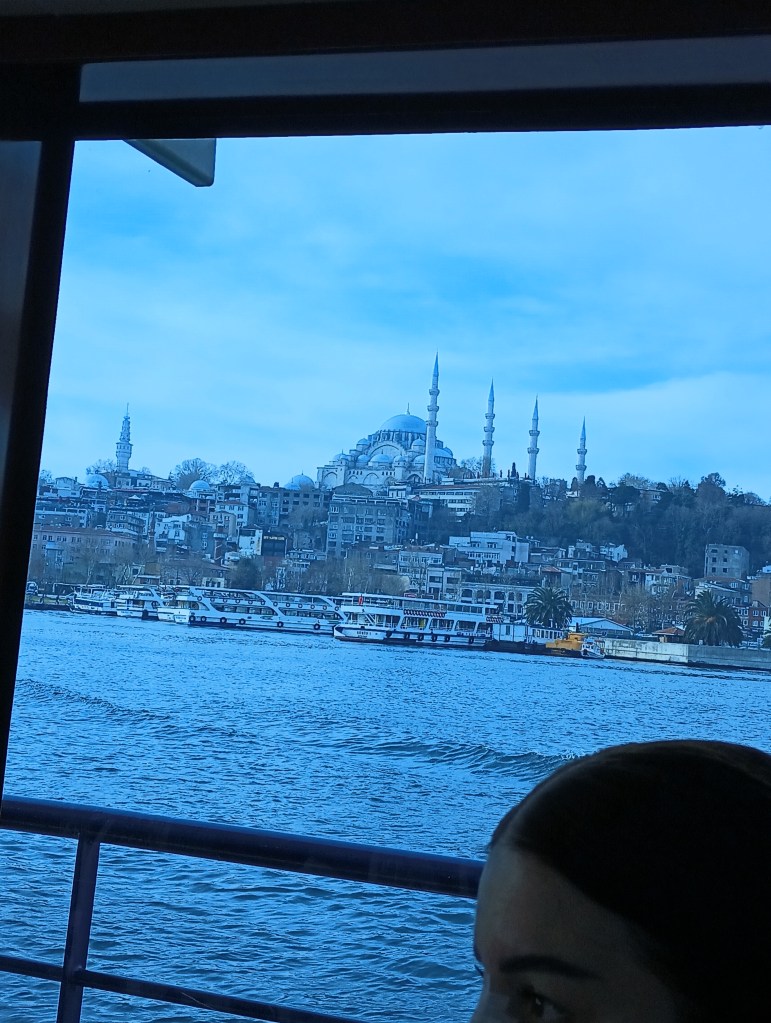
Time for a Bosporus view of Istanbul

Waking up for my one full day in Istanbul, I pack, make my way to the hotel’s reception desk, and have them stow my luggage until the evening taxi to the airport.  Fatima, the concierge who had messed up my tour date, was sitting blithely at her concierge desk. I approached. She of course acknowledged the scheduling confusion, and then our conversation went on from there as I waited for the T-9 tour to begin.

She was a beautiful doe-eyed woman, I would guess in her late 20’s.  Well mannered and professionally attired.

“Fatima, I must acknowledge that deep sadness you all must feel about the tragedy facing your country from the earthquakes’ horrible  effects.” A second large earthquake had just happened the previous day, which added to their misery.

“Thank you,” she replied, as her face softened, and eyes deepened. “Yes, it is very painful.  I have lost many friends.” She went on to provide details of those whom she had heard perish and those who had been providing her reports.

Istanbul was more than 1000 kilometers from the epicenter of the quakes, yet the effects on the mood and economy and logistical organizing functions of Turkey’s biggest metropolis were palpable and profound.

“You know, as hard as this has been for me,” Fatima continued, “it has been more difficult for Naseem (the other concierge who was so calm with me the night before).”

“How so?” I inquired with some trepidation.

“Naseem is Syrian. He is from Aleppo and has come as a refugee. A week before the earthquake, he had traveled back home to bury his mother who had died from an illness. Then he returned to Istanbul, only to discover that the earthquake soon took many in his family. A family already separated by war and death.” Fatima said all this in a slow, almost emotionless manner.

In my reaction to Fatima’s words I expressed empathy as best I could.  I told her that it seemed odd, almost an expression of indifference, to be taking a normal tourist jaunt to see the sights. But also, it was important to provide Turkey support, even if it is simply economic support.  I had previously asked for a place to contribute to the relief effort and gave a nominal amount to that cause. Now, I would carry on with my 36-hour tourist function.

I waited outside the lobby for a while until the other tour participant made it downstairs from his room.  His name was Mohammed, a 30-something, powerfully built Pakistani-American from New York. He clearly appeared to work out a lot, a perception that was confirmed frequently by him the rest of the day.

Mohammed had immigrated to Brooklyn as a teen and told me the classic hard-working-immigrant-makes-good story. He was now married with four children. An acknowledged non-devout Muslim, he nevertheless was devoted to his mother, proud of his accomplishments in business (he ran a service which catered to wealthy clients, like Cardi B and Bill Gates), and was a caring and responsible dad to his children.  He also showed me – unsolicited mind you – a picture of the Moroccan prostitute whose services he had secured the night before (probably why he was a bit late to the starting gate that morning.) And yes… of course I demurred at his offer to see more pictures or get her WhatsApp number.

Mohammed and I climbed into a van which wound its way through the warren of narrow two-way streets leading eventually to the waterfront and the boat that would be the starting off point for our tour.  Istanbul is massive.  A megacity of somewhere between 15 and 20 million people. Apparently, no one really has a grasp on the actual non-official population, as it is a waystation of souls going hither and yon from catastrophes to hoped-for havens. But the inner city street grid is humorously – or more responsibility labeled dangerously – inadequate to its task.  Frequently on our passage to the boat, our van or oncoming vehicles would need to retreat in order to find a way to pull off to the side and let the other vehicle pass.

The van drivers knew no English, and there was no “interpretation” of the city we were moving through.  So, the tour clearly had not begun. Nor did it begin when we were pointed in the direction of the boat and told to come aboard.  We waited close to 30 minutes on the boat, while other tour group members joined us, but finally, the tour got underway with orientations by two guides who would trade off with explanations of the city’s sites and histories in heavily accented Russian, Turkish and English.

Istanbul, the “crossroads of the world” was certainly showing its propers by the diversity of the tour participants.  Of the 50 or so tourists on the boat, only Mohammed and I were acknowledged USA Americans. I saw and/or talked with Brazilians, Columbians, Peruvians, Turks, Italians, Germans, Dutch, Swedes, Canadians, Asian Indians, Chinese, Nigerians, and lots and lots of Russians.  

Funny thing about being an American.  Or probably more specifically an old, tall, single, white American. More than once on this trip, I have been asked to BE in a picture with families. Not take a picture of them. Rather, have them take a picture of me with them. I felt like some kind of curiosity.  They must get back home and show their friends, “Look Natasha, here we are with a real, live American old man! Doesn’t he look funny?  And he talked with that hilarious flat accent just like the movies.”

It was so awkward, with hidden feelings and thoughts, to be talking with Russians. We clearly were in a proxy war in Ukraine, yet I wouldn’t dream of opening up that can of worms. A Russian grandma, mother and college-aged daughter were traveling together.  The daughter asked me to join them in a picture.

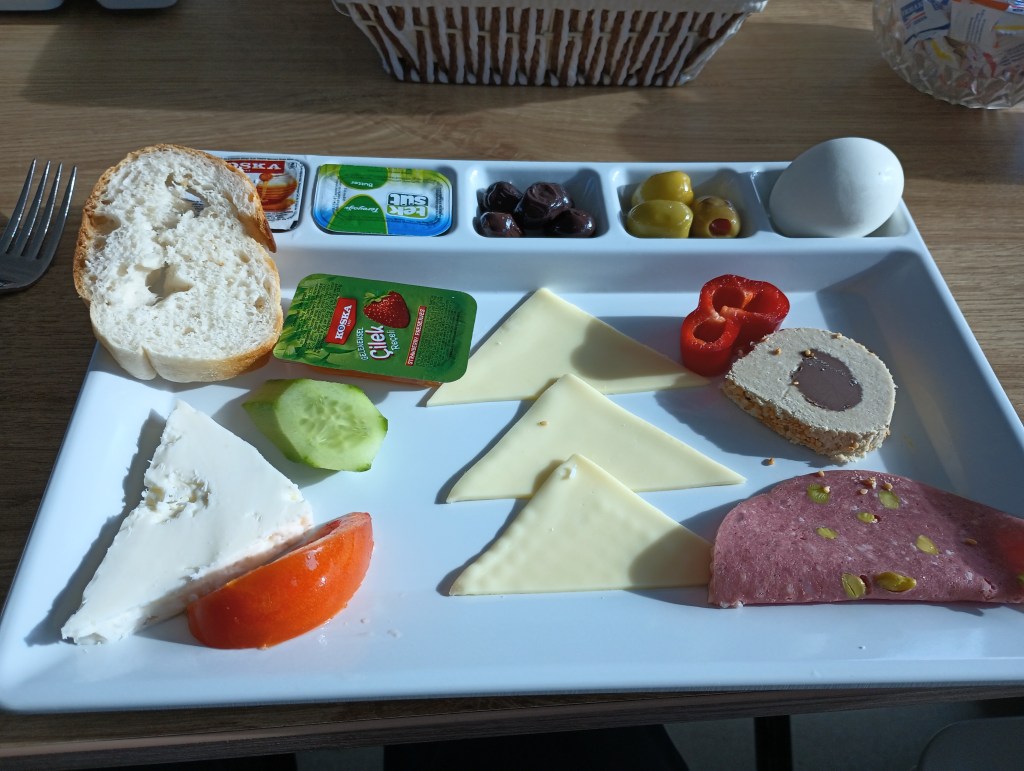
Kadir Agir was the name of tour guide. Funny, enjoyable and authoritative.  As we finally got underway on the boat, he described the day’s plan. First, we’d get a breakfast served in the covered hold as we traveled down the Golden Horn; a fiord-like bay on the European side of the city which was a key commercial focal point for thousands of years.

The breakfast was terrific!

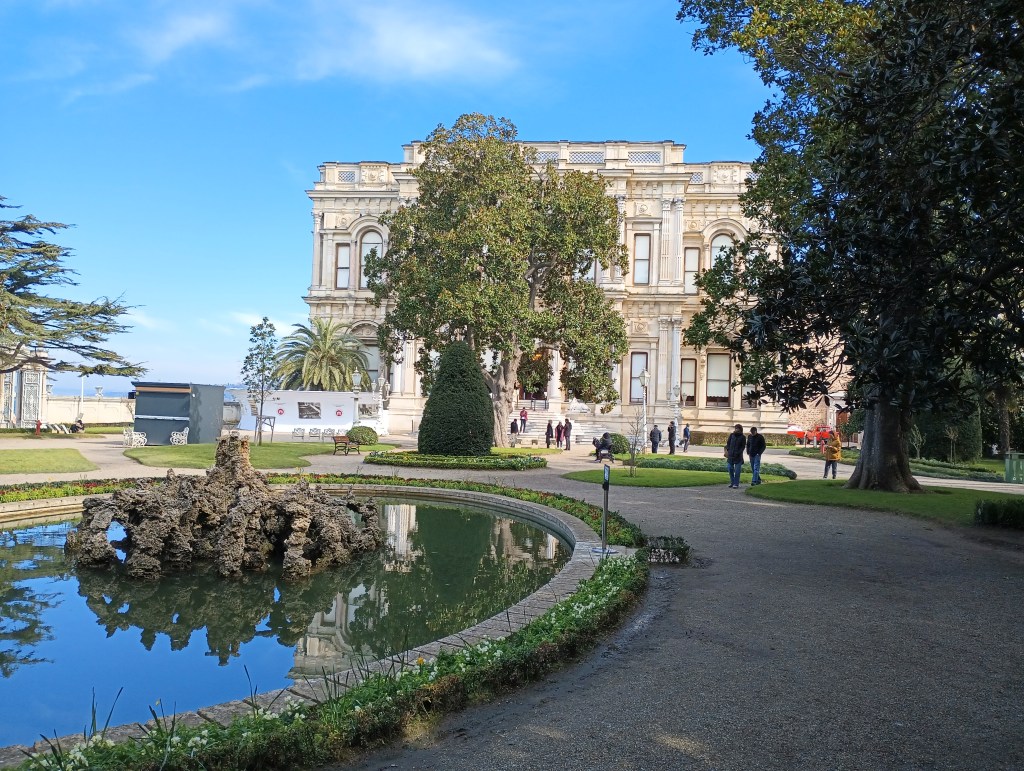
A Sultan’s summer palace.

After the meal, we’d go ashore and visit a Sultan’s summer palace.  Then we’d travel by boat up the Bosporus as Kadir would point out key historic sites. This would be followed by a bus trip on the Asian side to visit promontories and parks (including an elevated cableway ride). Then back over to the European side for a lunch overlooking the Bosporus, a visit to Erdogan’s recently completed Grand Mosque, and a ride back to our hotels in the Old City.

A few gleanings from the tour:

  1. The European side has most of the jobs, more of the people, and much higher prices for housing than the Asian side.  So, many of the lower-skilled workers would sleep in Asia and commute 4 hours a day for jobs in Europe.
  2. Erdogan and his supporters have made major efforts – with much success – in moving away from Ataturk’s vision of the country led by a secular (non-Muslim) government. That evolving vision is displayed in many ways in the built environment. For example, the Hagia Sophia (https://en.wikipedia.org/wiki/Hagia_Sophia) was built as a Christian church about 1500 years ago, converted to a Muslim mosque, converted by Ataturk into a national museum, and now converted back to a mosque.
  3. There is a grand synagogue still prominent from the Bosporus, but visitation is only through a rigorous security protocol.

Inside Erdogan’s giant new mosque – completed in 2019

As is my usual pattern, I found myself virtually the only one asking detailed questions of Kadir.  I think he genuinely appreciated the explorations of culture and governmental structure and I enjoyed very much our interactions.

Earlier, I had asked Fatima if it was possible to visit some of the Old City sites on foot that I had hoped to see on the T-5 tour.  She advised that I tell the tour guide of my desire to be let off by the Spice Bazaar, and walk from there.  As our tour proceeded, a Peruvian student, Roxanna, who was getting her Masters in Business Administration in Germany, and I connected over our joint Spanish language abilities (Yes, Juani, I CAN speak and understand well enough for it to be a relief from the tower of Babel we were surrounded with). So by the end of our tour, Roxanna and Mohammed joined me for a walking tour of the Old City.

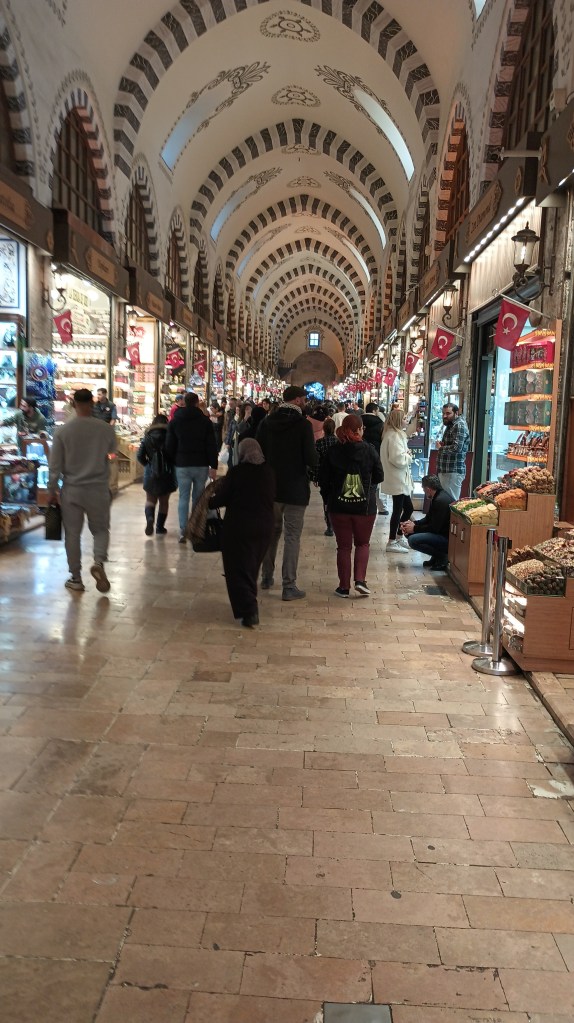
We walked into the explosively wonderful smells of the Spice Bazaar. Together we walked past  – but not into – the Hagia Sophia, Blue Mosque, Basilica Cistern, and Topkapi Palace.  We did dive into the enormous and lively Grand Bazaar.  Mohammed was in search of goodies for his children.  In particular he sought a present for his son who would be deeply disappointed if he didn’t get something, since the girls had already been shopped for.

Inside Istanbul’s Grand Bazaar

It was getting late, and I was exhausted.  So we walked Roxanna back to her hotel (the opposite direction as ours), and we had a small bite to eat before walking back to our hotel. (I got over 20,000 steps in this day, for which I was rewarded with fireworks on my wrist from the Fitbit.)

I was ready to pick up my luggage and head for the airport.  But first I wanted to give my thanks to Naseem for his encouragement in taking what ended up being quite a pleasant and informative tour.

“Naseem, “ I said. “Thanks so much for your help. You were right. It was a good tour.”

He politely inquired as to my welfare.

“Naseem, I hope it is not too invasive, but I want you to know that Fatima told me of the great tragedies you have experienced in your family and with your country. I am so sorry for your losses.”

As we walked with my luggage to the front door of the hotel and a waiting taxi, Naseem and I stopped for a moment. I asked him, “Naseem, how much loss can one person handle?”

He squared up, looking directly at me, and said, “quite a lot.” Then he reached out his arms, in the universal sign to come closer. Smiled a soft smile, placed his hands on my shoulders and kissed me on both cheeks.

At the embrace, I held back tears.

The taxi ride to the airport was relatively fast – well past rush hour – and the driver much warmer and talkative than the fellow who brought me to the Old City the day before. He liked Steph Curry and the NBA’s Golden State Warriors. At the end of the ride, my credit card and debit card still didn’t work. I used the last of my dollars to pay the fare and proceeded to hang out at the airport for several hours prior to the overnight to Johannesburg.  It was a whirlwind and emotional visit to a traumatized country. And I was ready to be embraced in another way. This time by family.

Traffic Jams and Winding Paths in the “Crossroads of the World”: Part 1

It was supposed to be quick, and it was supposed to be easy.

Walk off the plane bleary-eyed after an 11-hour all-nighter Seattle flight to Istanbul’s new and massive airport. Go routinely through passport control. Hop on a taxi and settle in for a good night’s sleep in the historic Crown Plaza Old City hotel. Then off the next morning on an Old City group tour of the Hagia Sofia and other classic highlights. Yeah… the blog entry’s title predicts the next sentence. There were plenty of bumps in the road.

Let’s list the bumps, shall we?

Bump #1: No one ever told me that Americans – and I think ONLY Americans – need a visa to leave the airport. Cost? $30… to be paid ONLY in dollars. I hear about this peripherally on the plane for the first time, but the reality fully dawns only after waiting 20 minutes on the Passport Control line, reaching the control agent, and being told that I need to go back and get the darn visa.

Bump #2: Like the perfect analogy for the entire Erdogan transformation, Turkey has closed the more central Ataturk airport to passenger traffic, replaced it with a grander, modern version more than 30km from the city core, and required visitors to support the Turkish economy by paying for taxi service.

My taxi driver spoke virtually no English and was determined to – and effective at – resisting my charming efforts at polite conversation.  When we arrived at the hotel, after an hour of wending our way through awful traffic – somehow both my credit and debit cards did not work on his machine. While I had sufficient US dollars to pay him in cash, my foreign journey had thus begun with the dangerous perception that either he had just somehow ripped me off, stolen my card identities, or my cards wouldn’t work at all. (Thankfully, I now believe none of that is true, but will await final word when I return to the States.)

Lobby of the Istanbul Crown Plaza – Old City

Bump # 3: Arriving finally at the hotel lobby – which was almost comically ornate for a middle-brow place to rest one’s head upon the pillows – I approached the concierge desk while waiting (for about 15 minutes) to check in.

“Hello, my name is Daniel Farber and I just want to confirm my reservation the next morning for the T-5 Old City Tour,” I say to a well-dressed gentleman standing in the small open office to the right of the hotel registry desk. The concierge, whom I later found out to be named Naseem, faced me with a polite but troubled look on his face.

“I’m sorry sir, but tomorrow is Tuesday, and the T-5 tour doesn’t occur on that date. Most of the sites are closed on Tuesday. Can we change that to Wednesday?”

“What?  No, I’m leaving the city Wednesday early morning.  Why didn’t Fatima – who had made the reservation for me – mention this?”

Naseem was calm and patient, and suggested that the T-9 tour would be lovely. I was tired, irritated and resistant. T-9 involved a boat trip, bus tour, and nothing in the Old City.  I had no interest in plying the waters of the Bosporus and Golden Horn. But Naseem gently extolled the virtues of T-9 and I came to grips with the reality of my situation. I didn’t have any choices for the next day other than solo explorations in a country where I didn’t know the language – at all.  Also, it hit me hard.  What did I have to complain about? This country was in trauma with the enormous tragedy of a devasting earthquake. My disappointments were petty. So, I signed up for T-9.

It appeared that every third store in this tourist area featured Turkish Delight.

Bump #4: Before going to bed, I wanted to buy some Turkish Delight for my South African and Israeli hosts, and get a small bite to eat. I asked the front desk about places nearby and was given directions which befuddled me.  So I took off on my own to find something simple. Two blocks down and around the corner was a street-side kabab place with a rustic back of the store sit-down eating area. Perfect. A cheap, authentic and tasty doner kabab where I appeared to be the only tourist in sight. Down it with Pepsi and I’m ready for a long night’s sleep.

A doner kabab and Pepsi hit the spot.

But then, there was the little matter of returning to the hotel.  I decided to make a big loop back home and proceeded to get completely lost.  Asked several folks “Crown Plaza Hotel” and in broken English after broken English  – or no English – I kept being given different instructions. My vaunted sense of direction betrayed me. But exhausted, I finally did make it back to the hotel and quickly fell fast asleep.

Next Blog Entry:  T-9

Travels and Travails into Autocracies: Past, Present and Future

A 2023 Journey to Türkiye, South Africa and Israel

In my enthusiastic naivete of autumn 2022, I wanted a trip to see family abroad. Dear Cousin Sybil in South Africa made it plain that 15-hour flights to America were no longer in her wheelhouse, and various Israeli relatives, beckoning since my initial 2019 foray into retirement, were now “Covid accessible.” While Jean demurred from long flights, I’d go anywhere. 2023 was to be all about “yes” and I was excited to get that underway with a flourish.

Cheaper flights could be booked on Turkish Airlines, and what the heck, why not spend 36 hours in Turkey? A quick sprint overnight to Istanbul’s Old City, a day tour of the Hagia Sofia, Blue Mosque, Basilica Cistern, and Topkapi Palace, and I’d be on my way to Johannesburg.  A nice way to adjust to the trip’s new time zone.

But post booking, events, both tragic and profound, intervened.

In Türkiye and Syria, the toll of horrendous earthquakes which occurred both during and right before my arrival now approach 50,000 dead.  An ongoing and worsening failure of the electrical grid resulting in rolling blackouts (load-shedding) and roiling politics (poisoning of the national administrator when he was blowing the whistle on corruption), is gripping South Africa.  And oh yes, Israel elected its most right-wing government in history, resulting in hundreds of thousands of protesters hitting the streets and yet more spasms of violence between Palestinians Arabs, Jewish West Bank settlers, and Israeli government police and military forces.

The streams between democracy and autocracy seem particularly fluid now within these three pivotal world nations.  All three have their feet in both “the West” and the “2nd World” of Russia and China. Their stances on the war in Ukraine, as the most significant current example, are complex and nuanced.

In Türkiye, growing autocratic rule by Recep Tayyip Erdoğan will be tested by an election set for May. The legitimacy of previous elections has been called into question by human rights NGOs, and some see the next vote as the last chance before anti-democratic rule settles in for a long run.  Both a part of Europe and a part of Asia, Türkiye borders Syria, Iran, the republics of the old USSR and the cradle of democracy in Greece.  It was the center of what was most certainly one of the most powerful realms the world has ever known for 600 years – the Ottoman Empire. So, it’s been pretty good at pulling off autocratic rule, and might find that comfort zone again.

In South Africa, the miracle that was the relatively peaceful transition from White minority rule under Apartheid to the Rainbow Nation vision of Nelson Mandela continues to both inspire and deeply disappoint.  There has been a complex shift over 30 years from centralized, systemic brutal authority to broadly condemned governing incompetence and corruption. A growing “anti-white” party regularly disrupts parliament. The white wealth bubble remains, with inequality, if anything, even worse than in the old regime. And yet… any yet… it all hasn’t fallen apart.  Violent civil war has not taken place.  A genuine black middle class has expanded.  And public facilities are legally open to all.

In Israel, the new government is proposing or enacting, amongst other changes, legalization of West Bank settlements, expanded differentiation between the rights and privileges of Jews and non-Jews, and limitations on the authority of the judiciary. When I asked my friend David “doesn’t this all seem existential to you?” he replied that Israel always feels like it’s on the existential precipice. Yet somehow, this feels different to me. Autocracy and democracy measured on the balance sheet once again.

The above all seems purely political; a far cry from my initial motivation to see family. But anticipate that these travel reports will be bits of the personal and the social. As usual, context illuminates, but people are the reason to move about the world. And so far – as you will soon read – what amazing people I have met!   

My Youth Literature Series “Publishing” Concept

About ten years ago, I came up with a concept for a children’s literature series. Inspired, I suppose, by the success of many series books, from “Curious George” to “Nancy Drew.” I nonetheless thought I saw an absence in the genre. There have been plenty of series books which involve a lead character experiencing various adventures of a similar kind, e.g., mysteries, fantasies.  There have also been plenty of books which follow a lead character as that character ages. The “Harry Potter” series is a prime example.  But has there ever been a literature series which progresses only in its level of sophistication as its readers age?  In other words, is there a series with essentially the same story, but delivered to children at their age-appropriate level from the first year of their life to age 17?

To implement this concept, writers and graphic artists would need to have a strong understanding of childhood intellectual and emotional development. I have neither. All I have is this concept.

So, over the years, I have told people “I have a concept that is brilliant, but just needs several people of great skill to carry it out.” I’ve taken it to writer friends. To lawyers to understand whether the “concept” is patentable (it is decidedly not!). To artists. To publishers.  The response has been consistent: “Interesting idea, Daniel, why don’t you do it?”

Well, the obvious answer is that I lack the skills and discipline to pull it off.  But then I just realized.  Hey, I have a blog now.  I can send this out to the vast array of my readership (ok… probably about 30 folks, most of whom have already heard this nonsense and most of whom don’t actually read everything I put out here), and see if anyone is open to changing the world.

And with that…here are some details of my publishing concept.  Anyone is free to use it, no credit or financial renumeration required.

Here is the distinctiveness of the concept:

  • We are talking about a publishing series; not just a “book” series. It would be made up of individual publishing events.  Each event would indeed include in form a book.  But it would also have derivative forms online of ancillary documents, games, other elements.
  • Each event would be geared to a specific child’s age.  The first event would be for a 1-year-old. the second event for a 2-year-old. The third would be for a 3-year-old… and it would continue up until at least age 13.  It could proceed to as far as 17.  The content and style of each publishing event would be age-appropriate consistent with the best understanding from the fields of children’s literature, education, as well as psychology/sociology.
  • For each event, the story would be essentially the same.  But it would be at an intellectual level that made sense.  Thus, the first “book” could have brilliant colors, shapes, faces, and other images with only single words associated with each “page.”  But as the sophistication of the story increases with age, there would be more than clear continuity of story line. It would essentially be the same story, with greater and greater depth revealed.
  • Each event would be revealed once per year.  There would be an initial cohort of children who could look forward to the next installment happening next year – hence the creation of a publishing “event” – building excitement for the next installment. 

Execution of the Concept

  • It is desirable – but not required – that the same illustrator would be retained for all events.
  • It is desirable, but not required – that a different writer/narrator be retained for each event.

In that way, children would have the maximum sense of continuing a journey with familiarity, but also be experiencing a new and creative take on the same story. From a writer’s point of view, it could be exciting to be a part of a successful series, and have responsibility to both the truth of the work of fellow writers, and at the same time, advance the story in unique ways that others would need to work with as each reader ages. From a publishing point of view, it would also be essential to have the very best writers of literature directed at certain ages. Thus, someone who would be best for a 3-year-old, may not be best for a 13-year-old.

Value of the Concept:  A Hopeful Conceit

This publishing concept could be international in scope, translated into multiple languages and published throughout the world. The theme and story line would ideally be a basis for expressing universal truths about humanity, and about the process of growing into adulthood. If successful, it would be:

1. A means of continuity throughout anyone’s childhood.

2. Something to look forward to as one ages.

3. Something to share between siblings and friends of different ages.

4. Something that binds people together of different cultures, languages and times.

There.  It’s out to the world.  I am curious though, whether it is a concept that is truly unique. Or if, somewhere, somehow, such a series now exists.