Retirement is an opportunity for exploration. Taking paths and then taking more. In Israel, where I first embarked on retirement for three months in the Winter and Spring of 2019, I learned that the word for path is Derekh. Hence the name of this blog.
(The following piece was part of a public presentation by students in Keith Eisner’s “Beautiful Truths, Beautiful Lies” writing class of which I am one member of 12 intelligent and generous students.)
When I was 17, I lived with my parents in London, England, while my dad was on an academic sabbatical. We rented a lovely second floor walk-up flat in the tidy Belsize Park neighborhood, a few blocks from Hampstead Heath. It was my senior year of high school. The plan was for me to spend the first semester with mom and dad in London and then return to the States by myself to live with friends for six months. I wanted to graduate on time.
It was the autumn of 1972 and I took to volunteering with the McGovern for President campaign’s London office. There is a long history of American presidential campaigns setting up shop in major European cities. They would wring as many bucks from affluent ex-pats as they could muster and send the dollars home.
Joyce, the campaign’s Office Manager in London, got used to seeing me come around every Friday afternoon to help. I would tube down to Piccadilly Circus, walk past the seedy striptease joints on Shaftsbury Avenue, then enter the tiny, cluttered campaign office to take on whatever menial task Joyce could throw my way. I’d stuff envelopes, run errands, and hang around with 30-something chain-smoking Joyce to talk politics. I thought she was very cool but did implore her – once too many times and unsuccessfully – to stop the nicotine habit.
One day, Joyce informed me that there was to be a “Gala for McGovern” at Global Village, located under the arches of Charing Cross Railroad Station. Among the celebrities planning to attend were Kurt Vonnegut, my favorite writer, and Paul Newman, who I admired and mimicked for his roles in Cool Hand Luke and Butch Cassidy and the Sundance Kid.
Gala day arrived. I had never really been part of anything of that sort. It was a bit like I imagined a Hollywood party to be, with ladies all dressed up and a wild and festive atmosphere surrounding the multi-storied site. Along with the other staff and volunteers, I wore a red, white, and blue McGovern t-shirt, signifying legitimacy (and avoiding the cover charge). Joyce set me up in front of the “Count the Jellybeans in the Jar” game.
I hated my task. The fundraising game area was almost an afterthought, hidden under a peripheral stairwell. Virtually no one was going there. You could hear the commotion and the tinkling of glasses outside our pen, and I wanted to be a part of it. Joyce kept on running around frenetically announcing the latest star. “Lee Remick” she’d squeal. “Ava Gardner, Nicol Williamson,” she gushed.
Rumors began to buzz that Paul Newman had made it to the event and would be speaking from the upper balcony. I decided to leave my lonely post to see if I could get a look and snuck deftly up the rear stairwell.
Just as I got to the top of the stairs, another McGovern for President official spotted me, and motioned me to approach.
“Paul is going to come out of that door to the right,” he whispered. “Stand in front of the door, and when the door opens, I want you to walk in front of Mr. Newman to clear the way for him to address the crowd. Over there, on top of the balcony. Can you do that?”
“Sure,” I said. “I can do that.”
I took my 6’4”, wiry 160lb frame and stationed it in front of the doorway.
The room was getting more and more filled with a mass of excited, slightly boozed humanity. The word must have gotten out as to the location of Mr. Newman’s entry, for a set of teenybopper girls began to coalesce right in front of me.
“Please, please, please let us in,” they squealed. “We want to see, Paul. Can you at least take this paper and get us his autograph?”
“I can’t do that,” I commanded in my lowest and most imperious voice. “But I’m going to touch him soon. I’ll give you my autograph.”
They fell for it. And for the next couple of minutes, I was signing autographs for 12-year-old girls who were thrilled to have them.
Then, the door opened. I didn’t look back. I just “felt” his presence.
“Make way,” I intoned, and spread my arms as I led him up a few stairs and over to a point of prominence. From there, he drew even with me and began his address to the assembled admirers.
My goodness, that man’s eyes were blue! He held his coffee cup in his left hand, and I stood aside him, about one foot away to his left, as he spoke about peace and justice and Nixonian horrors. I marveled at his calmness, his graceful motions, his famous smile, and his ridiculously blue eyes. Oh. Right. I already mentioned that last one.
As he finished his oration, he turned to me and said, “Let me be with the people.”
Just as he spun around to greet his admirers, my right upper arm “accidentally” brushed his right shoulder.
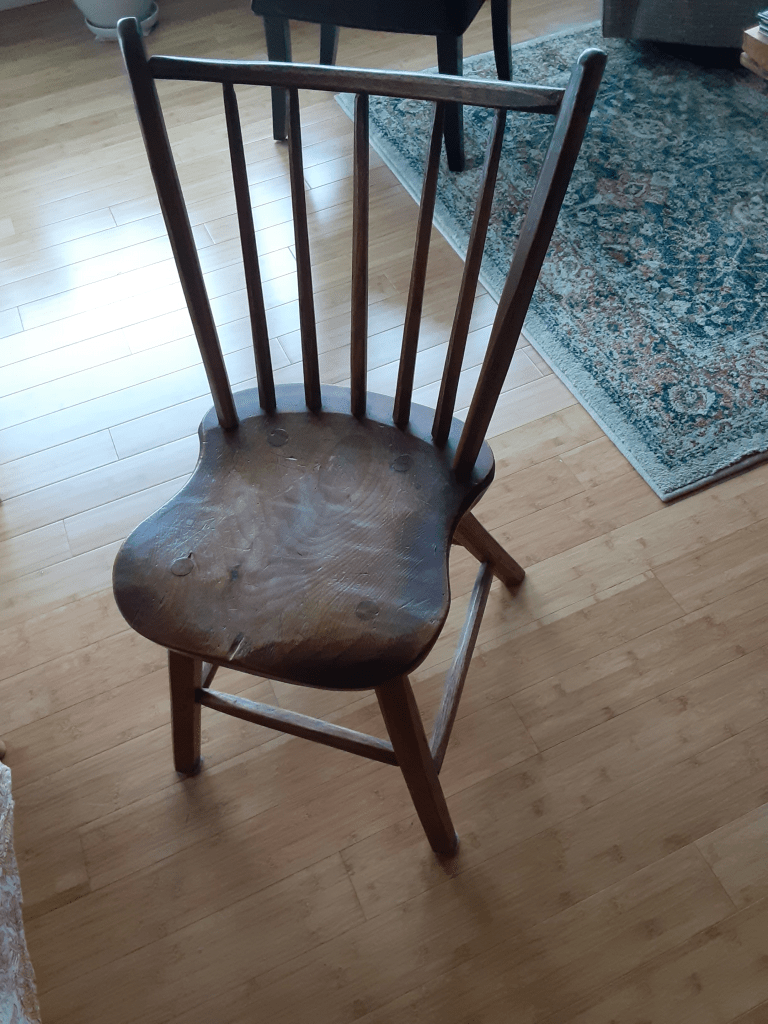
My son Zac, visiting from Minnesota with his partner Vicky, noticed yesterday that a peg on one of the dining room chair banisters was a bit loose. “I think this chair spindle may be breaking away, see?” he showed me with a worried look.
The chair is part of a knotty eastern maple dining room table, chair, bench, and hutch set that he has known all his life. And I have known all of mine. When my parents moved from New York to Seattle in 1955, leaving 3000 miles between family and friends, they brought along probably their most valuable possession – this Pennsylvania-Dutch handmade furniture set.
“Why are there three small chairs and one large one?” Zac asked. I explained that there were also two benches as we began to discuss where each member of my family of origin sat for dinner.
“Dad would be in the large chair at the front of the table, Mom on the opposite end and then… I forget who sat on the bench and who sat on the two chairs. Perhaps Ann and Laurie sat in the two chairs with me opposite on the bench? Perhaps the other way around?[1] I do remember that I was sitting closest to the kitchen.”
The conversation moved toward the role of a dad as head of the household and then on to the meals we ate. “We had specific dishes for specific days,” I said, as I strained to remember the details. “One day was spaghetti day, one day for hamburgers, another for hot dogs. No. Wait. We didn’t regularly do hot dogs.[2] But Mom made sure we had a salad at every meal.”
I spent 20 years, more or less, with my parents at that table. A good ten of which were with both my older sisters. And I can’t remember the daily ritual with any detail. Any certainty. I still have my sister Laurie to ask, who usually has a better memory for daily life than me. But she and I are all that are left of that family sitting around the table.
Why is it that daily life is so unmemorable? At least to me. Psychologists will say that memory is connected to deep emotions. Only great joys or great traumas stick around. There is sorrow in that. The years with your parents reduced to episodes.
The vast majority of our lives – 90% plus – are the day-to-day of sleeping and doing chores and eating and interacting with family. I ate thousands of meals at that table with those who loved me most and for whom I am most indebted for helping to make me who I am, yet those years now are but vagueness and incidents.
Counter that with not just the memories, but the life impact of experiences during travel. There is a vividness from voyages and an outsized sense of influence. So, let’s use up a few lines chronologically, exploring highlights, as I now recall them, of those episodes in my life that seem most significant. My times of breaking away from daily life.
To New York and Back
Our family flew, as I understand it, from New York to Seattle when I was six months old. No memories there. But we went back to family and friends in New York by train or plane three or four times during my childhood.
On one early trip, I’m guessing I was about eight, my sisters and I were in the train’s sleeping compartment and I was experiencing stomach distress for the first time. It wasn’t clear to me about the source of my discomfort. Laurie suggested that it might be gas, so she and Ann taught me “the farting position.” Ass up, head down, and let the gas rise to meet its freedom. Wow! It worked! And it was really fun too! I was conscious of this being a key stage in my maturity, knowing that adults farted all the time and now I would learn the tricks of that trade.
There were three other indelible experiences on those early train rides:
Entering a Chicago train station, seeing a large scrolling neon weather sign that read “90° FAIR” and then exiting the train onto an outside platform almost choking on the hot dampness. Growing up in the Seattle area, I had never experienced combined heat and humidity and I thought to myself “nothing fair about this!” It was the first time I knew that life was different in different parts of the globe.
Hanging out in the train’s “Vista Dome” by myself and watching American diversity roll along. As a child, it was an extraordinary opportunity for both safety and exploration. The passing landscapes were both mesmerizing and educational. I remember feeling an overwhelming compassion for poorer folks hanging laundry in small backyards adjacent to the tracks. In other stretches, excited to see the essential alignment of commerce and industry to the lifeline that was the railroad.
Watching the movie “Made in Paris,” an Ann Margaret vehicle, with my family on the train’s small screen movie car. That movie became the butt of family jokes for years as the “worst move ever made.” But we would preface it with the promotional line “there’s movies on the B&O!” and then off we’d go on some tangent.
Leaving the Country
In living only 120 miles from Canada, we did take trips to Vancouver occasionally. Pitch-putt golf in Stanley Park, sleeping at the Sylvia Hotel, the only time I remember our family paying for overnight accommodations in a big city before I was ten, and visiting the wonderful Museum of Anthropology at UBC. A BC-based basketball competition between the Seattle and Vancouver Jewish Community Centers was the occasion for my greatest athletic heroics. But that one will have to be a story for another day.
The first significantly impactful, personality-forming foreign travel was the 1967 visit to Mexico with my parents. By then, my two older sisters were off to college, and at age 12, I was still pre-pubescent with a tight and loving relationship with both parents. Mexico was a chance to really connect with them when they weren’t in busy, working mode.
I have previously written about Mexico in my writing class. I just reread it and hereby adopt it to this piece in toto. It fits this writing’s theme, and I’ll move on to other travels. (“Mexico as Muse” has been added as a November 2020 entry in this blog.)
At age 14, I traveled to Europe for the first time. The plan was for me and my sister Ann to spend a month together, hitching around Britain, Ireland, and Northern Europe. Ann was spending a year abroad in her final undergraduate year at the London School of Economics. Mom, Dad, and I would fly to London, visit friends and family for a few days, then the kids would separate from our parents and go our separate ways. We would meet up again at the New Experimental College in Denmark for the final leg of our travels.
What our parents permitted, and in retrospect surprisingly condoned, now sounds highly risky from my modern-day parental eyes. They trusted 21-year-old Ann to take care of her little brother. As we hitchhiked from youth hostel to youth hostel, stayed with friends or friends of friends, and explored historic sites, museums, and European daily life, this was an opportunity for massive maturation and self-confidence-building experiences.
Ann and I set off north from London and we quickly got the hang of hitchhiking. We were an unbeatable duo! Ann put her hair in pigtails. We made calligraphically lovely hand-drawn signs for each destination with the word “please” added in bright colors. I was still pretty small at the time, and together we appeared as an innocent, altogether cutely safe couple. One little old lady picked us up saying “I’ve never picked up a hitchhiker before but you two look so sweet.”
Scanning our International Youth Hostel travel booklet, we not only had hostel destinations to achieve each day, but special sites to explore. In Helmsley, we explored my first castle ruins and smelled the products from the nearby Roundtree Chocolate factory. In York, we scaled the old city’s medieval walls and toured its child-friendly Viking museum.
When we arrived in Edinburgh, we stayed with Esmee Roberts, a social work colleague of Dad’s social work colleague Henry Maier. Esmee, in her 50’s at the time, was welcoming, warm, refined, and fun. She spoke with a strong Scottish brogue, with cadence and mannerisms matching her nation’s standard fare. And she was black.
“Bingo! I’ve got it now. I understand what racism is,” I concluded. “Culture is just about everything.”
I walked out onto the streets of Edinburgh and saw a bunch of teens hanging around the sidewalk. One of them came up to me and we started talking. They instantly recognized my accent as foreign. “You American?” one boy asked. I answered in the affirmative. Then the kids gathered round me and started peppering me with questions. They wondered why American’s were such racists. They wondered why we insisted on warring on the Vietnamese. No. They didn’t wonder. They outright opposed American intervention and started getting angry about it. And I began to feel a bit scared. I assured them I opposed our involvement in Vietnam, then quickly bid my adieu.
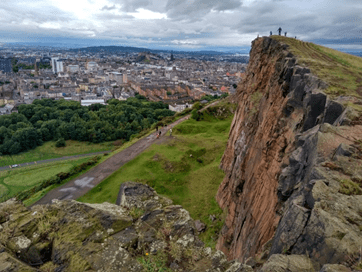
I walked off to Arthur’s Seat, the town’s central undeveloped mountain park. It was a cool, sunny, and breezy day. As I climbed the richly green pastures, replete with grazing sheep, the winds picked up. I had a light windbreaker on. At the top of the mountain, where the gusts were at their peak, I opened the jacket, grabbed each flap with my fingers, and outstretched my arms. Leaping into the air, the winds caught my faux sails and kept me, however briefly, aloft. For moments more than none, it felt like gravity’s hold was broken.
The view from Edinburgh’s Arthur’s Seat
Eleven years later, soon after the death of my father Arthur, I would awaken with a knowing smile on my face to the line “I learned to fly at Arthur’s Seat.” Twenty-seven years after that, Jean and I flew to our cousins Sybil and Arnold Castle’s flat in Cape Town, South Africa. The name of their apartment complex: Arthur’s Seat.
From Edinburgh, Ann and I took a train and ferry through Glasgow to Belfast, Northern Ireland. We were there two days before the infamous 1969 riots broke out. I remember feeling, even then, that the air was thick with tension. The place just didn’t feel right, and we decided that we would immediately hitch south to Dublin.
The Irish countryside was a deeply rich green, even in the middle of summer. We stayed in a hostel in the center of Dublin, and in our first full day in town, toured the Guinness brewery. That evening, we went to a pub. Sitting at a booth, a tall, dark-haired Spaniard came up and started chatting up Ann. She appeared to like it, but I didn’t. I told Ann that it was time to go back to the hostel, but she refused and kept talking to the man. I reiterated that it was time to go and what’s more, it was time to go the next morning back to London. With that, I went back to my hostel bed – men and women slept in different rooms – and didn’t see Ann until the next morning. Again, I told her then that I would be taking off to the ferry that morning and she refused to join me. So… off I went.
For no legitimate reason, I felt oddly calm and unafraid. I knew how to hitchhike, had all the proper maps, knew the addresses and phone numbers of contacts in London with my cousins. Piece of cake.
As I disembarked the ferry in Holyhead, Wales after a beautiful and uneventful passage across the Irish Sea, I stuck my finger out and immediately got picked up by a man in a formal grey suit and fancy car. At no time did I feel at risk or feel like my age was a matter of concern to the gentleman. He dropped me off at a youth hostel in a magnificent setting along the north Welsh coastal town of Penmaenmawr. As I was fetching my backpack from the back seat of the sedan, he opened up the “boot” and beckoned me to come back to him. There, filling the space completely, was an assortment of chocolate treats. Turns out, my driver was a Vice President of the Roundtree Chocolate Company – the same one we smelled in Helmsley – and insisted that I take as many treats as I could fit in my pack. I pleaded for mercy, but he kept adding to my load with a giant smile.
The youth hostel was a short walk from the coast, and it was there that I found out that blue mussels, a similar species that were so common in Puget Sound, were actually edible and delicious. I harvested a dinner’s fill with a fellow hosteler for that evening’s meal. He already had the wine and garlic for the steaming.
It was a good first day of my independence.
[1] A subsequent conversation with sister Laurie resolved the matter. The girls sat on the chairs and I was on the bench.
[2] The very same subsequent conversation with Laurie answered this one too. Thursdays were spaghetti night, when we eagerly ran upstairs for dinner immediately after watching “Huckleberry Hound” on TV. No other night according to her, and I trust her on these types of things, had a designated meal.
Sen. Robert Kennedy’s grandson Max found himself in Jared Kushner’s special “volunteer-only” Covid ad hoc committee. He was horrified by the lack of expertise assigned to this enormous federal responsibility. Soon after agreeing to join in the effort, he quit. He couldn’t participate in what he saw as an ineffectual charade.
The report on Max’s experience reminded me of one I had 28 years ago….
“I think I’ve got a 3fer,” I said to Bill, with an embarrassingly boastful air. Bill Daley was a former Mayor of Olympia, current colleague on the Child Care Action Council board, and an aide to Governor-elect Mike Lowry. I asked him how I could help Lowry, and he brought me on board the gubernatorial transition team.
Here’s the way it was to work. The month was November 1992. At Lowry’s transition team our task was to fill slots in about a dozen policy working groups. My group was titled “Land Use and Environmental Protection.” Each group of about a dozen “experts” was to have a representative demographic balance of age, sex and race/ethnicity. A “3fer” met the traditionally excluded of all three categories – a real prize candidate!
“Hello, is this Janelle?” I inquired brightly.
“Yes, how may I help you,” she replied in an even-tempered, professional voice.
“My name is Daniel Farber and I am a member of Governor-elect Lowry’s transition team here in Olympia. Do you have a couple of minutes to talk now, or can you suggest a better time for me to call?”
I heard silence for a few moments before Janelle responded. “Oh, well, yes, we can talk for a few minutes now. What is this regarding?”
“Governor Lowry is forming a series of short-term ad hoc working groups to discuss critical issues facing the state and to assist him in developing an agenda for action in the upcoming legislative session and beyond. Your name has been brought to our attention as someone who could contribute to our work in the ‘Land Use and Environmental Protection’ working group.”
“Um… why me? I’m just starting out in my career. Why wouldn’t you want our Planning Director Jones or someone else with more experience?”
“That’s just the thing. We are looking for a wide range of input, from older professionals and younger, from those with much experience and those who are just starting out. Would you consider joining this ad hoc group? The group will be in place for only one month, starting December 1. It will meet in person twice on Saturdays in December and several times by phone in the evenings.” Was my statement a lie? Uh, not exactly, but….
“Well, I want to check with my supervisor, but I think I’ll be able to make that work.”
“Great. Can I give you a call next week to confirm?”
“Yes, that will be fine,” Janelle replied.
“Great. Bye for now,” I said in closure.
“Bye,” responded Janelle, still a bit nonplussed by the whole interaction.
The process and objectives kind of stuck in my craw. “I’m talking to this nice young lady, Bill, and she is clearly suspicious about why she is being singled out for this ‘great honor.’ I can’t tell her the truth, which is that the only reason we are asking her to be on the committee is that she is under 30, a woman, and black. It’s just awkward as hell.”
“Yeah… I know. But that’s what we are doing here. You know that people in those groups have been excluded from such committees in the past. Mike feels strongly about this.”
Now, I understood what Bill was saying and of course, as a political liberal, I had a certain consciousness about social justice issues. But the weirdness of the call with Janelle remained a reality, and just as I was getting my “3fers” and “2fers” that month, I was aware of – and had a measured sympathy for – the critiques of such efforts that no doubt came mostly from political conservatives.
I use, in the above paragraph, the terms liberal and conservative, not Democrat and Republican, because back in 1992, they were not synonymous. Our state had had a long tradition of liberal to moderate Republicans, as well as some racist, quite conservative Democrats.
Nowadays, things are considerably different. The political left and right have pretty much separated into the two American political parties, with each establishing a broad and comprehensive set of positions to universally distinguish one from the other. If you are “pro-choice” you are a Democrat. If you are “pro-gun rights” you are a Republican.
That process of party conformity both fascinates and appalls. What is it about we humans, that advantages conformity of views?
I look back on my civic/political life and think of all the times I dallied in Democratic Party politics and found myself unable to dig in deep. This aversion to fully buying into that group – or any group – has been due to my overwhelming tendency to see the legitimacy of different points of view. Add to that my discomfort – and disagreement – with the agglomeration of different issues into one platform, necessarily agreed upon in total.
At age 17, I volunteered in London for the McGovern for President campaign. At age 19, I was an alternate delegate to the Washington State Democratic Convention and volunteered to help Sen. Warren Magnuson get reelected. I also had my personal moment that same year urging Jimmy Carter to run for president, 3 months before he announced. At age 21, mom, dad and I controlled the Democratic neighborhood caucus and moved it away from Sen. Jackson and toward “Undecided.” But it never really stuck. I didn’t go all in for the Dems.
I’ve thought over the years, about people’s need to be wanted and welcome and part of something. For some, politics and politicians meet that need. The thrill of going to a Trump rally must be like that. I remember in 1988 going to a rally with Michael Dukakis just a few days before the election. It was a spillover crowd next to the UPS Fieldhouse in Tacoma. Dukakis was famously one of the driest, least charismatic presidential candidates ever. But I tell you with the certainty of my soul, just being there with the crowd and eventually seeing Dukakis and his wife Kitty come to talk with us “spillovers” was absolutely thrilling. I shouted my lungs out.
My sister Laurie told me once that she was indeed a “screamer” at age 13 at a Seattle-area “Beatles” concert (She has since denied it!). When the Mariners came back from a 6-run deficit to win 10-7 as part of their “Refuse to Lose” 1995 last ditch successful playoff run, I was part of that capacity crowd with my son Zac and I was exultant with my fellow 51,000 comrades. All smiles and shouts of joy as we walked down the Kingdome’s ramps after the game. We had all shared a life experience on the same side.
And then I think of shul. Joining a religious congregation is easy. Staying is easy. Being welcomed, an almost certainty. All you have to do is buy in – to some obvious degree – in the organization’s ethos and you’re accepted. We have this need to belong. We get reassurance in being part of a team. We get comfort when sharing in consistent, lifelong ritual.
But this need for belonging can also be dangerous. In an interview with Bob Woodward, President Trump can be heard to say “So, you’ve drunk the KoolAid, Bob” as he was asked to comment on America’s history of racial discrimination. Trump was being critical of what he viewed as Woodward’s group-think and was referring to the mass death in Guyana by the People’s Temple cult followers of Jim Jones. How ironic of him, of course, to make such a reference, for he is the one who said, “I could shoot someone in the middle of 5th Avenue and not lose a vote.”
Independent thought versus the succor of being part of a team. There is value in both.
On Jean’s and my trip through the Intermountain West, how bizarre it has become to see the wearing of masks so associated with both personal choice/freedom and being part of a group. We are seeing a predictable diversity of American ethnicities, cultures and social statuses. Yet how odd and how terrible is it that masks have become a group choice symbol?
I have been thinking about the strengths and weaknesses of the powerful and influential species – humanity – that I am a part of. What are the strengths of our resistance to authority? How does authority claim and maintain legitimacy? What does this say about humanity’s capability to not destroy the planet and ourselves? Who are the gatekeepers to collective sanity?
As we approach this crucial election, I see many differences I have with the mainstream of the Democratic Party. I am also terrified of the potential for autocratic anti-democratic (small d) trauma in a second Trump term, and beyond. But politics is not the only group identity occupying my days and shouldn’t be.
I suspect my approach to the balance between group participation and individual choice will be practical. I will continue to participate in group activities (temple, non-profit boards, etc.), civic efforts (voting and urging others to do the same), family and friendship connections, and individual and even iconoclastic beliefs and actions. A healthy balance of all that, nice reservoirs of skepticisms, and a willingness to continue to act on my judgments seems to be a reasonable way to move forward in these weird and frightening times.
Elevation determines life in the Intermountain West.
Thousands upon thousands of square miles of uplift of the earth’s crust over millions of years. 3, 4, 7, 13 thousand feet above sea level the land rose from the churning of magma below the primordial ground, and the squishing and squashing of the tectonic plates. The land rose – and still rises. And the snows fell and still fall. And the snows melted and still melt. Melted in the highlands, with overwhelming force, ripping and tearing the rocks, crushing one against the other, in massive erosive flows. Carving and carving the landscape.
When humans came, they needed water year-round. They needed plants and animals to eat. They needed wood for heat. They needed rocks and mud and wood for shelter. And for all that, they needed elevations. Not one elevation, for not one could supply all that they needed. They needed many elevations. Warm enough in the winter to survive. Wet enough in the summer to survive.
At Mesa Verde, for thousands of years, they found what they needed. They figured it out. Climb high enough to have access to trees. For the elevation between 7,000 and 9,000 feet grew ponderosa, limber and pinion pines, Engelmann spruce, Douglas fir, and subalpine fir. Wonderful trees, that provided food and shelter and shade. Climb high enough and then dwell in the cliffs for protection from both the weather and other humans.
At Mesa Verde it was the very sheerness of the elevation changes that promoted civilization. That advanced civilization. That allowed permanent communities to form.
But throughout our travels to the Intermountain West, we have traversed immense stretches of relative sameness. West by southwest from Mesa Verde, we drove for hundreds of miles through the Navajo reservation to Flagstaff, Arizona. As elevation ranged between 6 and 4 thousand feet, the trees shrunk down to the “Pigmy forest” of pinions and junipers, and then disappeared completely. The rabbit and sage brush took over and then even they couldn’t abide the unrelenting dry scorching days and freezing nights of the desert, leaving nothing but rocks and sands at the lower elevations. Bleak, brown, bereft, barren, we drove through the “b’s.” Desolate, dark, dim, deserted, we drove through the “d’s.” Add two scoops of extreme poverty and the corona virus pandemic, and you get to the “g’s” of gloomy and grim.
The “Star Wars” city of Mos Eisley was a more welcoming place than the Navaho’s largest community, Tuba City, as we passed through at noon. Nothing was open, save a gas station. The unincorporated town of about 8,000 was on a nearly complete Covid lockdown. The only restaurants we saw were national fast-food chains, McDonalds, KFC, etc., and they were all closed. 100 miles down the road was another Navaho community called Cameron. Everything there was closed, as was the road from there to the Grand Canyon’s eastern entrance. We needed to drive all the way to Flagstaff, another 100 miles or so, just to relieve ourselves. Safeway had never seemed such an oasis of civilization as its pot to pee in.
But then Flagstaff was again over 7,000 feet and the ponderosa’s proved it. The much more verdant drive north from there to the South Rim was less grim, but still a measured drama-less sameness. There is no hint to what lies in store when one reaches the Grand Canyon. No peekaboo views of the giant hole. No smaller side canyons or cuts to the earth. Just miles upon miles of ponderosas when the elevation rises, and junipers, pinions and rabbit brush when it dips.
Grand Canyon Village on the South Rim is a settlement. Again, like Mesa Verde, it is the steep elevation change that draws humans. But this time, civilizational settlement is not based on survival, but on the international attraction of wondrous aesthetics that rapid elevation change creates. The Village has a train station, commercial center, hotels and residences. It has trails for horses, bikers and pedestrians above the rim. And it has, of course, the mighty Bright Angel and Kaibab trailheads, where thousands of people take off or arrive to test their fitness, trying to go “rim to rim” through 27 miles of canyon.
The Hopi House at the South Rim, focuses on selling the arts and crafts emanating from the Navajo reservation. That which I saw as the location of desperation and bleakness just the day before in Tuba City, was also a source of beauty and creativity. The economics of trade, however, can seem the opposite of justice. I couldn’t help but think of the relative wealth of the tourists purchasing crafts from the relative impoverishment of the artisans.
The Southwest national parks, national monuments, and other public places preserved for all to enjoy and appreciate, all seemed to have major elevation relief as a core to their value and draw. Chasms, gaps, voids, ravines, crevasses, and arches. The Grand Canyon is, of course, the largest, deepest Canyon in the area. But its structures are somehow understandable. Its cliff faces vertical and largely flat.
Here, the forces of water, wind, tectonic plates, and time just decided to have lots of fun. Those natural architects created “look at me” shapes, that will not endure for more than a few more millions of years, but we, the lucky, happen to arrive at the right time to take a few pictures.
We learned, at Bryce, that there is an order to all this altitude madness. Bryce, Zion and the Grand Canyon National Parks, as well as the Vermillion Cliffs and Grand Staircase Escalante National Monuments are part of a larger story of elevation and relief. That tale is of the rising of the earth’s crust and then the subsequent erosion, sediment loading, pressure and time that created layers upon layers of differential sedimentary and metamorphic rocks with differential erosion rates. At different elevations, these differences play out in different rock faces and forms.
Bryce, it turns out, is the highest part of the story. We drove to its southern rim, more than 9,000 ft above sea level. Grand Canyon’s bottom is the lowest part of the story. In between is Zion National Park. It was to Zion that we went next on our trip.
Ah… Zion. Zion is heaven, of course, speaking biblically. It is Jerusalem, or rather the mountain upon which Jerusalem sits, or rather the concept of a central place upon which G-d directed David to create his holy city or rather the overall concept of a central holy place. Or it is a bit of all those things without a singular specific meaning. When I lived last year for three months in Jerusalem, I just knew, I just felt, the city’s holy might. It was Jerusalem that drew me to Israel. It was a tug at my soul.
Thirty-five years ago, I went to Zion National Park with my then girlfriend, and future wife, Karen. I remembered it as the most beautiful place I had ever seen. Thirty-five years later, as we were about to enter Zion, I still FELT it as the most beautiful place I had ever seen. The reality proved my memory right.
What is beauty? What is the holy might of beauty?
Zion’s sheer cliffs, its soft mountains, its river valley floor are all stunning contrasts to almost everything we have seen the last two weeks. Zion is verdant! Even at the end of September. Its seeps and streams and rushing waters, its fine mists, provide habitat for ferns, mosses, bullrushes, and massive cottonwoods. It has emerald pools. I repeat. It has emerald pools! It is lush, luxurious, and leafy.
Zion Cliffs and Valley, carved by the Virgin RiverEmerald Pool, Indeed!
After Zion we were ready to return home. We had two long drives ahead. The first across southern Utah all the way to northern Nevada. This was plumb down the center of “The loneliest road in America.” The broad, flat valleys were at 5 to 6 thousand feet high and the mountain ranges we would cross periodically brought us up to 7 thousand feet and a tad more. Rabbit brush yielding occasionally to junipers of various heights. The only reason it was less bleak than Navajo lands was that there was little pretense that people could actually live in such a place. Over 80% of Nevada is owned by the federal government, most of that by the Bureau of Land Management and the Department of Defense.
Our overnight destination was Elko. Back to Mos Eisley, this is probably a much closer analogy to that town. Elko is built on avarice and a goodly number of the remaining seven deadly sins. It is a mining town. Copper, silver, gold, lead, zinc, mercury, tungsten, manganese, iron, uranium, and antimony have all been harvested in the hills around Elko. It is a boom and bust city now very much in the latter stage. The biggest city of the 4th largest county in the continental US, Elko now looks like a depressing mess. Boarded up casinos. Brothels out of business due to Covid.
No one to ease the pain of the pandemic at this establishment, Elko Nevada.No place to waste your money, time or reputation during the pandemic, Elko, Nevada
I looked up the town on Wikipedia. It’s a self-proclaimed “conservative” town politically. Voted for Trump 75%-25% in 2016. Trump signs are everywhere. Elko has a Basque heritage and we are recommended by a friend to go to a certain Basque restaurant. We order takeout and I go to pick it up. Walking through the bar to get to the takeout counter is like a Covid concourse. Tattooed ladies in low-cut tight shirts. Tattooed young men, laughing – and coughing – as they guzzle their beers. I come up to a young staff person, who is not wearing a mask, and ask her if this is the takeout counter. She says yes and asks me for my order. I say I already provided it and am here to pick up the food. She goes back to the kitchen. I peer in as she talks with unmasked cooks. Turns out, they mistakenly sent our food out with a delivery woman. Oh my. I return to the hotel room where we are staying only to find that the delivery person never came because she forgot part of the order. We cancel the order.
But here’s where it gets fun. Instead of Basque, we get food from a Palestinian-run Mediterranean restaurant. I pick it up and have a great conversation with a middle-aged couple from Bethlehem. I tell them that I was there last year, and we chat amiably for a while. “How’d you end up in Elko?” I ask. It is anyone’s most obvious question. Turns out their parents were there and that they didn’t want to live in a big city. So, even if Elko, at the moment, is a certifiably hellhole, it’s got great hummus and falafel.
Boom and bust. Boom and bust. Elko will elevate again!
The cliché that “travel is broadening” has taken on a special resonance these past few days, as Jean and I departed our home in Olympia the day before a smokey closure of the skies restricted and narrowed people’s daily lives. Friends and relatives throughout the world emailed us, hearing and reading of the hellscape that has become the West Coast of the United States, asking in grave tones of concern about our welfare.
Our reality though, a mixture of relief and embarrassing luck, is that we headed to Spokane, just as Olympia was driven inside by the smoke, and left for Yellowstone, just as Spokane joined in the company of the miserable. The air quality forecast for the next days as we head for Moab then Mesa Verde then the Grand Canyon is all reasonable and “moderate.” We seem to have gotten away from the center of trouble.
On the other hand, not really. Or not for long.
As we have driven 80 mph – yes, that’s the legal speed limit – down the byways of the Intermountain West, I’ve been contemplating the notion of vastness. Montana, Nevada, the Dakotas. They all have symbolized the American idyll; a kind of mythic emptiness. I’m humming “I Can See for Miles and Miles” by The Who.
The American road, where “travel is broadening,” is about an opportunity to lose oneself in that vast emptiness.
When I was 11 years old, Dad, Mom and I drove across the country from New York to San Francisco, mostly along I-80 or its 1960’s pre-Interstate forerunner. The miles stretched out across open, relief-less plains. We measured each day by distance traveled. There were days where we “made good time.” Others where we slept-in a bit or stopped long enough to smell a few roses. But to my child’s time perspective, it all seemed to go on forever. This land, this Country, seemed endless.
Now, I am wistful for that perception of vastness. The world all seems to be caving in on itself. The air pollution from China wafts its way to Puget Sound. The air pollution from California streams in satellite images across the troposphere to New York. And beyond. Invasive species slip past ecotones. The unseen Coronavirus breaks out in Wuhan. It cannot be contained anywhere human stupidity, narcissism and ignorance reign. Oh, that there were borders to contain such contagions! Where is the vastness when you need it?
Has my professional land use and parks planning background removed me from the magic of vastness? Now the miles and communities all seem inter-related. I can see the uniqueness of each place and the relationships of each place to all others. There is an all-too familiar ecological reckoning that turns the 1000 miles of Montana into discreet and even fragile segments. Where is the vastness when the whole is understandable?
For some, the vastness lies within.
LDS Temple undergoing seismic retrofit, Salt Lake City
Jean and I were greeted by two young women in the gardens of Historic Temple Square in Salt Lake City yesterday. While the streets outside the square were nearly devoid of people – even during a weekday, downtown SLC felt quasi-deserted – the square had a few pairs of young, modesty dressed women walking with casual purpose, greeting touristy folks – like us – with smiles and hellos.
“How are you,” one of them asked us.
“Just fine,” was my polite reply.
Those two words were sufficient cause for them to stop and talk. One was a Korean-Canadian named Ms. Kim. The other, Ms. Fiu, was of Samoan heritage. What soon became obvious, was that part of their LDS mission work was doing exactly what they were doing with us. Engaging visitors in conversation. Conversation with a goal.
“Do you have any questions for us?” asked the Samoan waif.
“Yes. Thanks.”
Jean and I – mostly I – asked several questions. Why is the Star of David on the Assembly Building? What does it look like inside the Temple? (They had a series of photos and pictures prepared for the inevitability of such questions.) What portions of Temple Square are open to non-Mormons? Why do LDS adherents now shy away from the term Mormon?
Their responses to our questions were quite helpful and knowledgeable. It was important for Ms. Fiu to sprinkle the name Jesus into her sentences, but nevertheless, she was responsive and relentlessly positive, as was Ms. Kim, about all our inquiries. Then the time for questions of us started – with a bang.
“What do you think the purpose of life is?” Ms. Fiu asked.
Jean and I looked at each other. I hesitated, so Jean moved first. “The first thing is to do no harm.”
“Yes! That is important,” Ms. Kim said with an attentiveness seemingly borne of practice.
“I’m a retired teacher,” added Jean. “So, for me an important purpose of life is to help others.”
“That’s wonderful,” said Ms. Kim. “That’s true for me too. How about you, sir?” All three proceeded to turn to me.
“I agree with what my wife said.” I paused to think if there was something more I wanted to add. There MUST be something more to say, I thought to myself. I didn’t want to offend the young women, but I also felt like life was more than usefulness.
“I also think the purpose of life is to understand more and more about the universe. The vastness. The awesome beauty of it all. And to as fully experience what it means to be human as possible in this short short time we are here.”
Ms. Kim seemed to take in what Jean and I said. Internally reflect upon it. Ms. Fiu, on the other hand, had work to do.
“For me, the purpose is to better know Jesus,” Ms. Fiu said with a wide smile that had her face mask fall below not only her nose – which had been the previous position – but now below her mouth.
Then, came the predictable question from Ms. Fiu.
“What is your religious background and your relationship with Jesus Christ.”
“Well, I’m Jewish. I have no relationship with Jesus.”
Ms. Fiu was taken aback and a bit confused. Jean took a moment to add that she had a Catholic upbringing, but they were not interested in that. The focus went back on me.
“What do you mean, no relationship?” asked Ms. Fiu.
I explained – and seemingly needed to – that Jews believed in the Old Testament, not the New Testament that had Jesus as its central figure. Just like many Christians did not believe that the Book of Mormon was divinely inspired, Jews didn’t believe either of the two newer books came from G-d.
What I didn’t say was that I didn’t believe in the supernatural. What I didn’t say was that the science of cosmology was, thank you very much, as awesome as awesome gets. That the human ability to contemplate the vastness of the very large and even the vastness of the very small was a gift that, if not giving life some directed purpose, gave life enough meaning to satisfy my need for purpose. Satisfied my need to enjoy being alive.
Those two young women seemed really happy, actually. Leading pleasant and purposeful lives. Ms. Kim, provided evidence of connection to the larger popular culture, knowing about and enjoying the CBC show Kim’s Convenience. Ms. Fiu, not so much. She hadn’t heard of Melanesia, even as she knew she was Polynesian. She really didn’t seem prepared to learn about other views in the world as “legitimate” compared with the truths she had discovered and now espoused. She spoke with joy about the potential to join her family in the hereafter and live with them forever (a certain hell for many I know). But all of us. Ms. Fiu, Ms. Kim, Jean and I, expressed a need for awe. A need to understand our smallness in a wondrous vastness.
Leaving Historic Temple Square quickly added to our confrontation with Nature’s awesomeness – and not in a happy way. A freak windstorm had hit the city just the week before with 100+ mile per hour winds. The power was still out in parts of the city. Huge trees lay upended on the sides of residential streets and gigantic limbs lay cracked on the sidewalks which in turn were cracked by the limbs. Pandemics, race riots, leadership disasters, firestorms, economic catastrophes and did we really need windstorms?
In what had become a theme for our trip, we moved on to safer climes. Moab. The desert. Surely fires can’t get us there! We drive south through the “moderately” polluted air to one of America’s foremost centers for outdoor recreation. It is there that we had the immediate opportunity to contemplate the vastness of time and its ability to turn the improbable into the obvious.
Arches National Park contains over 2000 natural land arches. 67,000 acres of rosy sandstone, scraped and blown and freakishly contorted by the ages into formations of beauty and power. The explanations by parks interpreters seemed reasonable enough. For millions of years, the area was under an ocean. Silt deposits eroded from ancient mountains built, layer upon layer, thousands of feet thick of sandstone. Then the earth’s continental movements pushed that land mass higher and higher until it rose far above the sea. Differences in the density, strength and composition of stone layers resulted in differences in erosion rates. Water infiltrating the rock, freezing, and breaking that rock differentially, eventually resulted in the awesome spectacle that draws folks seeking inspiration from throughout the world.
Surreal Land Forms at Arches National Park
Everything about the national park makes one feel small. Even the very small. The dry flat land base of the park’s floor contains an odd mixture of bacteria, mosses, fungi and lichen called cryptobiotic crust. It takes hundreds of years for this crust to form a protective layer, and a single human foot to destroy it. The cryptobiotic crust absorbs and holds moisture. It reduces erosion. It enhances habitat so that a variety of arid-loving plants and animals can thrive. And it needs humans to protect it. Now THERE’s a purpose, Mses. Kim and Fui!
Tomorrow, we will take to the river. Rivers have sources and rivers have destinations. We will raft the Colorado, jump into the flowing waters, bob and weave through the currents, balance our own volition with those of one of the continent’s most important water bodies. We will have no effect on the river, though it will provide us with memories and meaning.
The Colorado’s flows will accompany us on much of the rest of our journey. It gouged the canyons of tomorrow’s Canyonlands National Park and for 5 more days, Grand Canyon National Park, where we will walk and lie astride millions of years of awesomeness.
There is a vastness in the contemplation of the ages. I am not yet inured to wonder.
Daniel’s Derekh contains the Hebrew word for path. But there is no reason that that title cannot be used for my path post Israel. I am, afterall, as we all are, still on a path.
After returning from Israel in the Spring of 2019, I decided to take a writing class at the Thurston County Senior Center. As it turns out, the style of writing has often been a kind of memoir-lite, much like my Israel writings. So I’ve decided to use this blog as a means of both storing my writing and sharing it with those who might have an interest.
Upon returning from Israel in early May, several people at our Temple Beth Hatfiloh synagogue came to me and expressed both their positive impressions of my blog and a desire to have me do something Israel-related at TBH. I wasn’t sure what to do and neither were they. So I got together with Rabbi Seth Goldstein to talk about it.
The topic of Israel is a very sensitive – even raw – one in our community. Olympia is the home of the Olympia Food Coop which was the USA’s first grocery-type store to join the BDS (Boycott, Divestiture and Sanctions) boycott of all Israeli products. As a charter member of the Coop some 40 years ago, that action caused me to quit membership, and the boycott continues to be a significant cause of pain and alienation for me and many others in our community – both Jewish and non. Olympia was also the home of Rachel Corrie, a student at The Evergreen State College, of which I am an alum, who was crushed to death by an Israeli bulldozer in 2003, while trying to protect a Palestinian family’s home from demolition. That death became a cause celebre for the international Palestinian rights movement.
TBH’s relationship to these larger internationally significant issues has been fraught. The temple has lost membership. Friendships have ended or been strained. And the topic of Israel and our American Jewish relationship to it has been downplayed because of it.
It is in this context that Rabbi Seth and I talked about what exactly we wanted to do and say about Israel. Rabbi Marna Sapsowitz, TBH’s former principal Rabbi who is still an Olympia community member, had encouraged both me and Rabbi Seth to use my blog as an entry point for conversation. When Seth and I sat down to discuss this, he indicated that he did not see a productive conversation coming out of people describing their political positions vis-à-vis Israel and Palestine. I agreed. While I provided observational views and political/historical context in some of my blog entries, it was easy to see how delving too deeply into that might risk any dialog quickly devolving into unsettling and unsolvable semantic and political argument.
What we determined was more promising was an opportunity for people who had ever visited Israel to more directly describe their motivations for going there and their actual experiences and insights. It turns out that 6 TBH members had been there in the last few months and many more had been there in the last two or three decades. So we decided to have a facilitated conversation about American Jewish Identity and its relationship to Israel as part of a Shavuot educational session. I would lead off with a description of my own motivations for Israel travel and then facilitate others in doing the same.
Last Saturday night, the event occurred. About 40 people turned out and about 10 ended up speaking about their experiences. I distributed out to folks the following “instructions” for their informal talks:
If you are open to talking a bit about your experiences visiting Israel, here are some guiding questions to help structure your contribution to our discussion:
When did you go and for how long? If it has been more than once, can you describe the frequency of your visits and any significant differences between the different visits?
Who did you go with?Why did you go? What were your motivations? What did you hope to see or learn or accomplish or otherwise experience?
What are your current connections to Israel (familial, practical, spiritual?) and how does that relate if at all to your perception of your Jewish Identity or the Jewish Identity of loved ones?
I then led off the evening reading out loud the following material:
On October
14, 1980, my dad was a dead man resting. Convalescing at a health-oriented
moshavah in Israel after flying in a couple of days earlier from India, he
thought he was feeling a tad better that morning. Along with my mom, his travel companion, Dad was
on sabbatical from his teaching gig at the UW School of Social Work; studying
intergeneration wellness communities throughout the world. The Israeli moshavah was one of those
communities.
Clearly, that moshavah analysis was the most immediate reason for his visit to Israel. He knew of no Israeli relatives at the time. As a secular Jewish man brought up by irreligious parents, he was not planning a visit to the “holy sites.” Yet, he wrote in his journal that October 14th day of his father: “Charles was such a stirred up, spiritual soul! Why have I been fooled by his railings against the ‘bombast of the religious’ and not seen his own deep and abiding well of Jewish sentiment.” Dad wrote on: “I now feel the shma closer to me than ever.”
The next day, Mom and Dad visited Beit Hatfootsot, the Museum of the Jewish Diaspora at the University of Tel Aviv. It was there that Dad’s dysfunctional mitral valve gave up on him and he died on the museum floor.
14 years later, I visited that same museum with my aging mom, who was already showing the debilitating signs of Alzheimer’s. It was my first time in Israel and Mom’s second. At that time, my own feelings about Israel were decidedly mixed. Emotionally drawn by the many heroic stories of its pioneers, I felt connected with Israelis as part of my Jewish identity, yet also highly critical of Israel’s politics and policies in relation to the Palestinian Arabs.
It was in
that first visit to Israel, that I met dozens of relatives. I reconnected with an Israeli musician friend
whom I knew from Seattle. I traveled
from the northern tip of the country to its southern tip. And for the first time
in my life, was surrounded by people who wanted me to join them. Join them in what? Join them in the great adventure of building
a Jewish nation. Every day there was
exhilarating. Fascinating. At times
disturbing and more than once a bit scary.
But it was undeniable. I felt a
kinship with these people, even though I did not speak their Hebrew language. A
kinship with my Haredi relatives, oddly enough, no less than my secular ones.
I’ve gone back twice since that first visit almost 29 years ago. Most recently for 3 months from early February to early May of this year. When I got back this time, I was encouraged by Rabbi Marna to share my experiences with the TBH community. I had been writing a blog that she and a few others had read, and she felt I had something to say. As it turns out, 5 other TBH members had also been in Israel at the same time I had been! So after talking it through with Rabbi Seth, and some of my fellow Israel visitors, we decided upon this event that we are now about to dive into.
For it is
not just 6 of us who have been to Israel.
Many community members of TBH have gone to Israel. And it is not a stretch to conclude after
conversations through decades with a lot of them, that their Israel experiences
were an important part of their decision to explore their Jewishness. To remain
Jewish. To join TBH, or just to keep a heightened attention to Jewish or
Israeli topics.
Tonight, we
want to have an opportunity to hear from each other about our experiences in
going to Israel. But because just about
everything about Israel is controversial, emotionally sensitive, and a source
of potential vulnerability, we want to put some structure to this discussion.
((It was at this time that I made sure that the “instruction sheets” were available to any who wanted one.))
A bit of
context before we dive in.
Why is Israel important to many of us? In the spirit of counting the Omer, which we just finished earlier today, let’s look at the numbers (Wikipedia, 2017).
Our connections to Israel are emotion, spiritual and for many of the people you will hear from tonight, highly practical. What the world population figures tell us is that if you are a Jew in the 21st Century, the highest likelihood is that you are either an American or an Israeli. And the back and forths between these two countries will continue to be major factors in the evolution of Jewish identity. Israel’s second language is clearly English, with New York accents all around you as you walk the streets of Jerusalem, Israel’s largest city. Conversely, estimates of Israelis now living in the US (mostly in the New York and Los Angeles metro regions) range from just over 100,000 to upwards of 500,000.
Conclusions
In my presentation I then went on to talk about my motivations for going to Israel, which you, my devoted blog readers already saw discussed in the most previous entry.
It was a very satisfying evening. People had an opportunity to express themselves about their intimate experiences with Israel that had been built up over many years. Some of these experiences were quite lovely. Others, frightening or troubling. But collectively, the richness and complexity of the relationships were revealed.
I’m not sure whether a follow up to the Shavuot discussion is called for or would be useful. It had value as a moment of expression and insights for those present. I can see it would have been valuable too for many others in the shul who have been to Israel or may go in the future to have similar evenings. We’ll see if there is that interest, but for now, I am thankful to have had the opportunity to share my Israel experience with others. And I hope to have the opportunity to return again to family and friends soon.
On the first post in this string of stories along my Israeli derekh, I laid out an initial rationale for the three-month visit to Israel. Now, as I write in my basement office at home in Olympia, having returned about a week ago, let’s revisit those expectations and see how they match up with my experiences.
A “Clean Break” from a Work-Centered Life
What I Wanted: First of all, I want a clean break from my work-centered life. Many folks who retire from full-time professional work, find an emptiness that needs filling. Find a need to redefine self, now that a large part of their identity is stripped from them. Without a major and consuming break from past habits, I might find the road to the next stage of my life more subject to inertia than positive choices.
What I Got: For many years, my professional work consumed almost all my creative and intellectual energies. Add in the very real sacrifices of multiple moves, geographic separations from and long drives to wife Jean, and intense seven-day work week requirements, and you have a guy who made choices (or the world forced certain choices) that resulted in a distinct imbalance between work life and non-work life. The reality was that for the most part, I actually thrived in that world. It filled me with meaning and consequential decisions and a frequent and vigorous sense of delight.
How could I leave that world and still fill my yearning for continuing intellectual stimulation as well as an ongoing sense of purpose?
With that question in mind, I filled – over-filled – my time in Israel with commitments. Not only did I enroll in language school (ulpan) for 3 hours per day, 4 days a week, but I also committed 10 – 20 hours per week of intellectually challenging volunteer work, and also sought connections with relatives and friends that took me away from “home” in Jerusalem for about 2/3rds of my weekends. I also wanted to feel like a normal Jerusalemite, so I joined a choir which met weekly, and joined a table tennis club, which also met weekly. In my effort to make a clean break from “work”, and in my fear of lacking “purpose,” I clearly took on more than I was capable of executing with high quality.
In the ulpan, I was the oldest student (by more than ten years) and found that toward the end, I just wasn’t able to keep up with the rest of class. I still enjoyed my time with my fellow students, was able to make progress every day I was there, and did form a much stronger base for learning if I wish to seriously pursue Hebrew in the future. But I am not sure my aged brain can take it on with the capabilities it exhibited 19 years earlier as I took on Spanish immersion.
In my volunteer efforts, I was not able to finish my commitments on time. I did deliver two worthwhile presentations, gained insights into the professional planning environment in Israel/Palestine, and most wonderfully, am set for continued research and writing over the coming months that will both complete my volunteer commitments and provide opportunities to explore ongoing stimulating activities. Maybe even compensated work that I would both enjoy and be very different from the professional work I did prior to retirement.
In the words of my clean break goal above, I feel like I have before me many “positive choices.”
Exploring my Jewish Self
What I Wanted:Secondly, I want to explore my Jewish self…. I want to connect with my relatives, some of whom are quite elderly, while I still can… And I want to explore Jewish practice and culture.
What I Got: Toward the end of the trip, I became aware of a set of relatives I didn’t know I had. Some I was able to briefly meet. Others, I couldn’t find time to connect with. But all through the stay in Israel, I prioritized meeting with cousins and friends and families of friends. And everywhere, with every person I reached out to, I found people who were warm and welcoming. Without exception.
Some of these folks, I was able to spend a fair amount of time with. Cousin Danny Brahms and his partner Shirley in particular deserve my heart-felt thanks for their hospitality and care. Cousins Hemy and Anat were extraordinarily generous with their time and talent (the food was unbelievable!). They were genuine in their hospitality, and intelligent and engaging conversationalists – add in brilliant and socially skilled children and sweet and intelligent grandchildren – and you understand why I left Israel feeling that I left not just relatives but people who would be my close friends if only we lived in the same continent.
Some of my relatives are secular Israelis. Others make religious practice central to their lives. I asked all of them about their connection to Jewish ritual practice and saw that each person had found a solid home in Israel whether they lived fully secular lives, fully observant Haredi-ritualized lives or something in between.
Beyond the homes of relatives and friends, I also attended various places of worship. From the musical-oriented kabbalat shabbat at the Reform shul Kol Haneshama, to an Orthodox shul where men and women pray separately. I walked the streets of Mea Shearim, and prayed at the Western Wall. Even in exploring many Christian sites I had never seen (Jerusalem’s Church of the Holy Sepulchre, to Bethlehem’s Church of the Nativity, to Nazareth’s Basilica of the Annunciation, to the Church of the Loaves and Fishes along the shores of the Sea of Galilee) I was exploring my Jewish self and my reaction to those sites.
And while my Hebrew skills are not now as strong as I hoped they would be, I certainly can read and write with greater speed and accuracy (understanding is a different story). So as I continue to explore my Jewish self, I have a better grounding now to do so.
Closure
Three days ago, I went to Costco to get some groceries and asked a staff person where they keep the falafel mixes. He didn’t know what falafel is. Nor did another staff person I asked.
As I walked today from my house on the West Side to downtown Olympia, I passed about thirty homeless folks in tents residing for the time-being under the 4th Avenue Bridge. I never once saw a homeless person sleeping in a tent or on the street in Israel the last three months.
When I returned from Israel, many people asked me if Iwas ok there or if I was frightened by the bombs that were dropping everywhere. I tell them I was not, although apparently 4 Israelis and 25 Gazan’s were killed the last weekend I was there, before a ceasefire was arranged just in time for Ramadan. I explained that for the most part, the dangers for Israeli Jews are in those portions nearest Gaza. For Gazans, and for Arabs in the West Bank to a lessor extent, the hazards are far higher. But even with all that intensity, the day-to-day life for most Jewish Israelis now feels safer than the average American. Women of every age walk the streets of Jerusalem at any time of the day or night.
Wherever I went, people asked me in Israel if I were going to make aliyah – if I expected to immigrate. I told them all the answer was no. It was not my intention. But I also told them that I loved being in Israel and that I will miss Israel very much when I go back to America.
And so here I am, back home. Feeling very much an American. Very much part of the American Jewish diaspora. And feeling exactly as I told all my Israeli relatives, friends and acquaintances I expected to feel. That is that I loved being in Israel, miss it very much, and hope I can find a way to come back again and again.
In the 1950’s, 60’s and 70’s, when the kibbutz movement was in full flower, foreigners wanting to help in Israel knew just what was expected of them: get on your hands and knees and start digging in marginal agricultural soils. Or spread the feed in the chicken coops. Or take care of the wee ones, while other able-bodied youth picked the yellowish Jaffa oranges for export to a scurvy-adverse European market.
For this retirement launch, I too wanted to contribute in some meaningful way to Israeli society. I wanted to be useful, in part because that is intrinsically satisfying, and in part because it selfishly could provide an avenue to explore my curiosities about Israel and about myself as I age. But digging up carrots in the field was not on the agenda. My body couldn’t hack it and any old machine would be more helpful to a farm than trying to train me.
Through an internet search, and help from an Israeli friend of the family, I chanced to link up with the organization “Skilled Volunteers for Israel.” As their web page describes it:
What we do: Through our extensive network of Israeli nonprofit and educational partners, we match you with a service project tied to your interests, experience, goals, and skills. We are there to orient you to Israel and help you prepare as you are welcomed onto the teams of our organizational partners.
All my feelers were up as I made initial inquiries into the organization. It functions as a matchmaker – a Shadchen – between volunteers who have had professional careers and want to contribute skills developed in those careers – and organizations that could use those skills. My skills are unusual. And as they interviewed me for the purpose of truly understanding my interests and abilities, looked at my resume, which they required me to provide, I quickly felt that these folks were asking the right questions and had a genuine desire to help me have a wonderful volunteer experience. As it turned out… they proved to be not only great matchmakers, but extraordinarily helpful in leading me through a number of logistical issues – not the least of which was finding me a perfect place to stay in Jerusalem.
Instead Of
My principal volunteer commitment in Israel has been to an organization called Bimkom, which in Hebrew means “instead of.” My parks planning colleagues will note that I am obsessed withe the “alternatives” stage of the planning process, so this match just felt right.
I encourage you to glance at Bimkom’s website here. Its tag line is “Planners for Planning Rights.” It’s been around for about 20 years as “an Israeli non-profit organization formed … to strengthen democracy and human rights in the field of planning.”
While still in the USA, Terry Henden, the Jerusalem coordinator at Skilled Volunteers for Israel helped arrange for a phone call between me and Sari Kronish and Ma’ayan Turner, Bimkom staff, as we explored potential work I could perform. Bimkom was working on projects that actually advocated against the establishment of certain national parks in Israel. The reasons are complicated, but they asked me “surely, with your parks planning background you are always in favor of new parks, right?”
“Well, actually, no” I replied. “There are properties that for one reason or another may not be worthy of park status.”
We talked. I asked more about the rationale for their objections and they asked more about my relevant experiences. We began to explore what they saw as injustices and non-equal treatment between Palestinians and Jewish Israelis in land use planning and development. I initially saw no relevant analogies in the USA between two potentially sovereign bodies, whose peoples may have different rights in the same property. Until… now wait a second… how about the sovereign rights of Indian Tribes and their members to carry out activities? And as our discussion went on, what emerged was a research and writing project for me that both fascinated them, and provided me an opportunity to delve into something that I have long sought to explore. My volunteer project emerged from those discussions. I would do a case study write up of the creation of the USA’s first joint State Park and Indian Tribal Preserve – Kukutali Preserve in Washington State’s Skagit County on the Swinomish Tribal Reservation. I would include other international examples of co-management of parks (e.g., Ebey’s Landing, Peak District), and explore co-management as a model for resolving disputes.
As the volunteer project has evolved, some of the most valuable elements for me – and they have told me for them as well – have been our conversations about what might be analogous and what clearly isn’t. And I have gotten a pleasant surprise out of the experience as well. I want to delve more deeply into this topic upon my return to the US. This volunteer opportunity in Israel has led to exactly what I hoped would happen from this retirement launch. A purposeful next act.
At the very northern tip of Israel, less than a mile from the Lebanese border, lies my family’s kibbutz; Kfar Giladi. For a brief and fascinating background on the kibbutz, click on this Wikipedia link.
In the fall of 1938, my mother’s first cousin, Shirshara Jaffe Itai and her husband Abraham, left their kibbutz, Kfar Giladi, with their 4 year old son Avner (they left baby Yuval to be cared for by the kibbutz children’s program) to come back “home” to Riga, Latvia where they had grown up. Shirshara and Abraham and about 100 others from the greater Riga area had traveled to Palestine about 7 years earlier to help build a socialist Jewish homeland. As the storm clouds of war were converging on Europe in 1938, in their youngest son Hemy’s memory of family lore, it wasn’t clear what their objective in going back was all about. It could have been to organize Latvian- and Lithuanian-area Jews to gather their possessions, say their goodbyes, and emigrate to Palestine. As quickly as possible. Or it could have been to gather political and/or financial support. Nor was the outcome of their effort clear.
But by the Summer of 1939, Shirshara, Abraham and Avner successfully made it out of Riga, and smuggled their way back into Kfar Giladi. Those Jews who didn’t leave would see Germany invade Poland in September, Latvia taken over the next year, and all would almost certainly then perish in the Camps thereafter. Jewish immigration into Palestine under the British Mandate was illegal then, and Kfar Giladi was part of a major smuggling route into the area.
80 years later, I am sitting next to Avner at the Kfar Giladi Passover Seder. The Seder is unlike anything I have ever seen or could imagine for such an occasion. The whole event an enormous production, with 700 kibbutzniks dining and singing along as music and dance and theater performances carry the multitude through 4 hours of bedlam. It is marvelous! And yes, these avowedly secular – and mostly irreligious – Israelis – go through the gantze megillah (whole story), chow down on Ashkenazim essentials (gefilte fish, chicken soup with matzoh balls, and far far too much food) and manage to make it through 4 cups of wine just fine.
With the exception of one verse in English of “Go Down Moses,” everything is in Hebrew. Avner kindly summarizes the gist of the evening to me as it evolves. An early dance number has a dozen young women and girls, dressed in biblical-era garb, formally expressing an Exodus scene in movement. Turns out that Shirshara, who led the dance and theater program at the kibbutz for decades, had done the choreography for this dance piece 50+ years ago and it is an annual tradition to have it performed at Seder.
For Avner, it is a deeply emotional reunion, as he both led music in the kibbutz for years, and hadn’t lived there for more than 50 years. His talents were viewed by the kibbutzniks as too great not to share more broadly, and all agreed he must relocate to the urban core of the country and pursue where those talents could take him. Avner went on to be Israel’s foremost choral director (see a reference to his career here), but at his heart, he still remains a kibbutznik. All through the night, former students come up to him to pay their respects.
The Pushing and Pulling of Migration
The core story of Passover, of course, is about the yearning for freedom that motivated the Israelites to migrate away from slavery and oppression and migrate to a promised land of milk and honey. The Torah, however, is not a single story, and history neither starts nor stops at any time period. For every action, there are complex causes and continuing consequences. The Israelites freed by G-d, proceed to defy his commandments, are punished by being required to roam homeless and stateless for 40 years, and then are allowed to enter into Canaan. In this final act of migration, G-d directs the Israelites to invade Canaan and slay every native man, woman and child so that they could not come back later and retake the land. This is what progressive rabbis would call “a challenging passage” of Torah. This also wouldn’t be the first or last time that the area now known as Israel/Palestine would be subject to violent invasions. Its peoples and their cultural supremacy would frequently change hands.
The underlying legitimacy for Jewish settlement in 19th Century Palestine (conceived predominantly under the concept of Zionism) had both a push and a pull rationale. The push was the all-too prescient belief that European anti-Semitism left Jews at risk of death if they stayed in Europe. The pull, was the notion of return to a land that was a core part of the ethos of Jews in the diaspora. The underlying tragedy and the basis for conflict since has been that the Jews were moving to a land already dwelt in by a different people. At the beginning of Jewish immigration into Palestine in the mid-19th Century, Jews represented an estimated 3% of the area population.
We now live in an era of human history where migrations of people throughout the world are both physically easier than ever before to accomplish, and also a profound source of tension which is leading to cruelty and violence. In every migration there is the ideal of freedom for those individuals either fleeing danger or yearning for a better life in a new land. In every migration there is the risk of unwanted or unfair displacement of indigenous communities. Every migration is chock full of real and potential heroics and injustices.
This last Thursday, on Holocaust Memorial Day (Yom HaShoa) at 10 am, sirens blared and most Israelis stopped driving or whatever else they were doing, and stood for two minutes of silence to think about the 6 million Jews who died in the Holocaust. But not all Israelis did this. At ulpan, I saw my fellow Arab students milling about, making themselves scarce at the appointed time. In a classic lack of empathy, many Arabs have been taught that the Holocaust was not real, or at least there were legitimate choices for the post-war Jews other than Palestine. In a classic lack of empathy, many Jews have been taught to believe that the Land of Israel (Eretz Yisrael) was “a land without a people for a people without a land.” Migration conquers all emotion and all reason.
My most thought-provoking experiences in this exhilarating visit to Israel, Jordan and Palestine have been when I have tried to juxtapose the daily lives of individuals I encounter with some level of understanding of the larger forces – historic, political, economic – at work on their lives. For most, though not all, of these interactions, a deeper understanding of each person’s relationship to their family’s migrations has been a key to the stories of their lives and those of their countries.



 Daniel's Derekh